
Every object here is haunted, and comes with its tale.
Artifacts & Curiosities
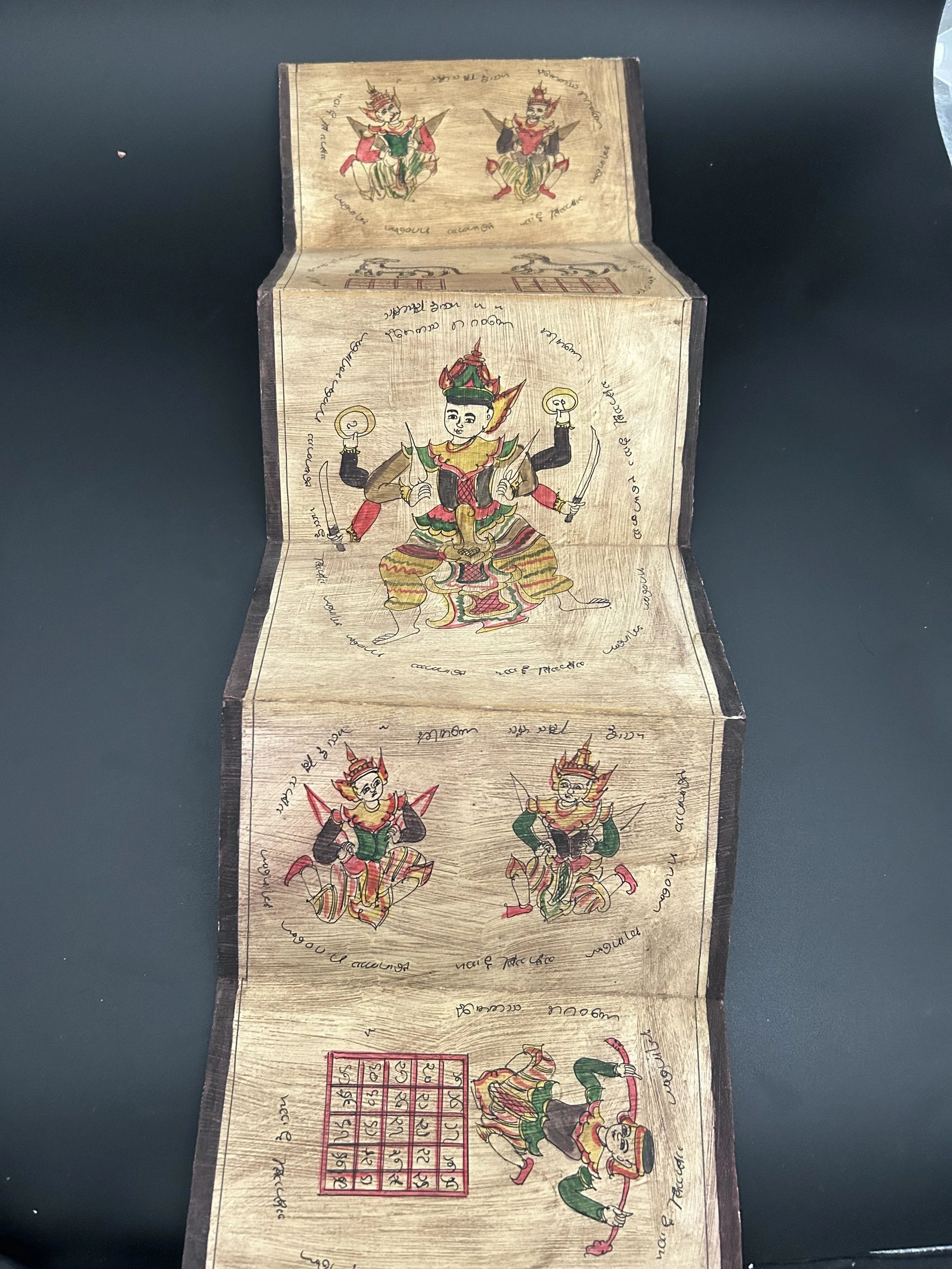
Item No. RSF – B – 4 – δ – 129
Object Description
A rare Burmese parabaik in the traditional folding accordion format, of the black, soot-and-lacquer working type used by masters for esoteric and astrological work. It is hand-illustrated with mythological and ritual figures, fantastic animals, and magic squares, inscribed in Burmese script, and bound between decorative lacquered wooden covers.
Physical Details
Paper, soot, lacquer, and pigment, with lacquered wooden boards. Accordion fold, with rubbing and wear to the folds and surfaces consistent with age and use. Overall good collectible condition. Early 20th century.
Dimensions
88 cm × 16 cm.
Tradition
A parabaik is a traditional accordion-style folding book of Myanmar, made from thick handmade paper. They served at once as practical notebooks and as artistic canvases, preserving state chronicles, royal court life, and esoteric knowledge until the European codex displaced them. There are two primary forms. Black parabaiks carried a blackened surface of soot and lacquer and could be written on and erased; they were used for daily records, sketches, calculations, and the working notebooks of astrologers and masters of the magical arts. White parabaiks were cream-colored, meant for permanent works, and carried formal writing and finished illustration. This is a black parabaik of the magical and astrological kind, the working book of someone who told fortunes and worked spells, dense with in (magic squares) and ritual figures.
Story
In the last days of the Burmese empire, a court astrologer began his revenge on the people he believed were his enemies. His name was U Thant Zin, and though kings consulted him, he owned little beyond a lacquer chest and a single black folding parabaik. He lived in the Rainy Temple. No one could remember the temple’s real name. As the astrologer worked his magic and his spells, the empire fell, and his library was scattered. A parabaik is a curious thing. Unlike a palm-leaf manuscript, it unfolds like an accordion, page after page of dark paper coated with soot and lacquer.
U Thant Zin’s parabaik was said to contain far more than horoscopes. When he died in 1885, shortly before the British entered the city, the manuscript disappeared. For decades no one knew where it had gone. Then, in 1923, a dealer in antiques bought out an abandoned monastery library near Sagaing. Among broken Buddha images and worm-eaten chests, he found a lacquer box sealed with red wax. Inside lay a black parabaik. He unfolded it by candlelight and saw a dancing array of Buddhist astrological figures and spells, and then he saw a picture that resembled himself, a figure thrown beside an overturned cart that was on fire. He shrugged off the gooseflesh that rose on his arms and closed the book. The next day a carriage carrying lamp oil ran him down in the street, overturned, and caught fire.
Years later, villagers along the Irrawaddy told stories of a wandering manuscript seller. He carried no books except a single folded volume wrapped in silk. He never sold it, though he always claimed he would. When curious buyers asked to see its contents, he would unfold only one page, and each person saw something different. A lost ring. A future marriage. A burning house. A distant voyage. Some called it a trick. Others swore the images came true.
The strangest account came from a monk in the 1960s, who said the seller allowed him to view the final page. The monk expected a prophecy. Instead he saw only an illustration of a black parabaik resting inside a lacquer chest. Within the drawing was another parabaik, and inside that one, another, the image repeating forever, falling away into darkness. When the monk looked up, the seller was gone, and only the scent of old lacquer remained.
To this day, Burmese collectors repeat a saying. A palm-leaf manuscript preserves the past. A parabaik remembers the future. And in antique markets from Mandalay to Yangon, if an unusually old black folding manuscript appears without provenance, experienced dealers will sometimes refuse to open it after sunset, because they fear it may already know they are coming.
Provenance
Tradition associates this type with the lost library of the court astrologer U Thant Zin (d. 1885). The present example is an early 20th-century working parabaik of the same magical and astrological tradition, Burma (Myanmar); acquired by Rooks–St. Felix at auction, 2026.
Supernatural Scale: 4
Communicative and prophetic. The manuscript shows its viewer images, and those images have a way of arriving. It is associated with the apparition of the wandering seller, and with the recursive final page that no one has been able to reach the bottom of.
Maintenance Scale: δ (Delta) — Advanced
This is not a piece for novices, and it is not a piece to consult idly. Advanced practice and real restraint are required. Do not open it seeking a fortune. Do not open it after dark. Keep it folded in its box, and understand before you acquire it that a parabaik of this kind is said to look back at the reader, and to remember what it has shown.
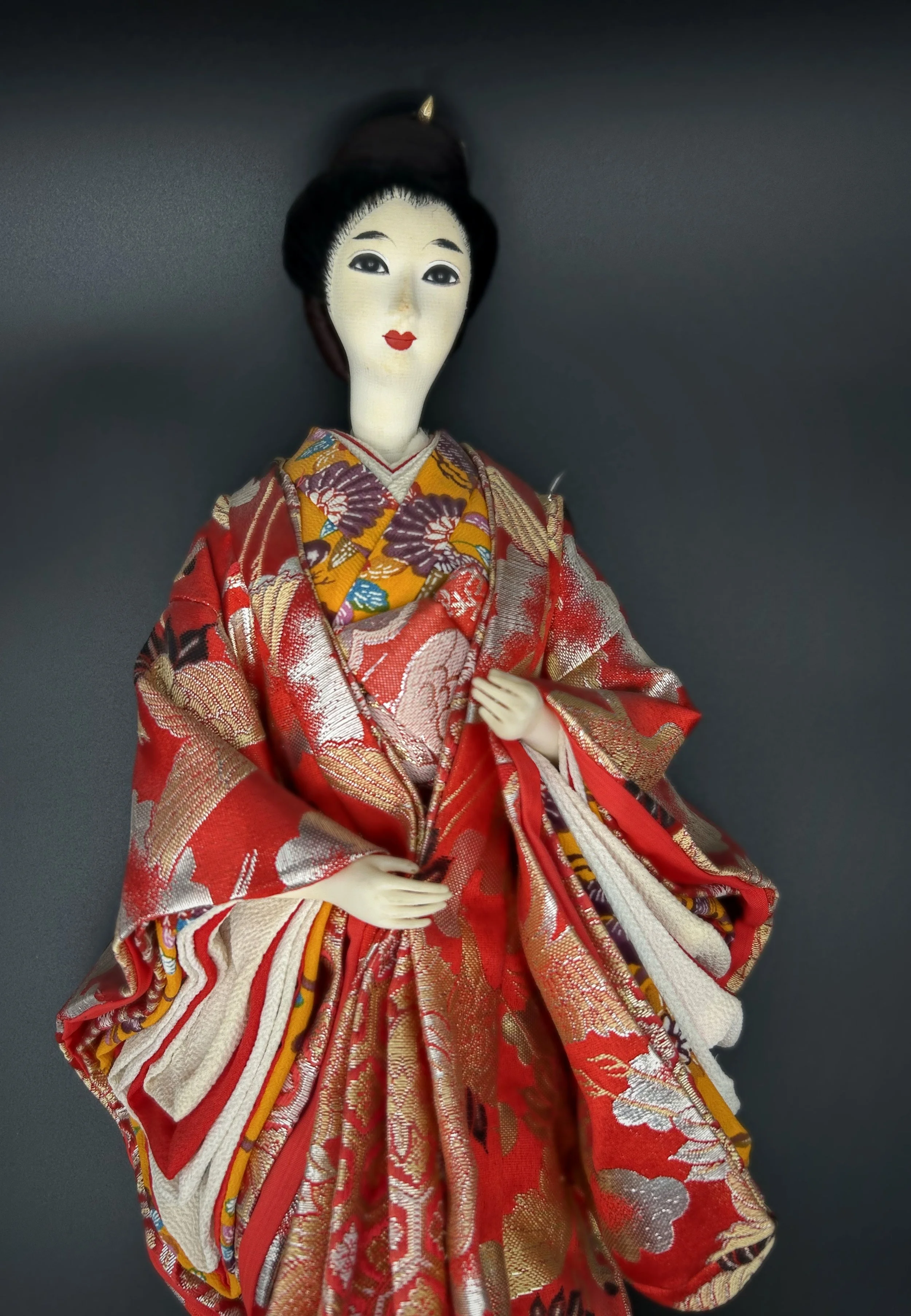
Item Number: RSF - D - 4 - γ - 22
Object Description: This is a beautifully dressed vintage Japanese doll known as an Ichimatsu Doll. This particular doll is in the Ryukyu style, which is inscribed in the Japanese characters on the base of the doll: 琉球人形 which literally translates to Ryukyu Doll. Ichimatsu dolls have been produced since the 18th century in Japan, and this style in particular became a popular souvenir for American GIs stationed in Okinawa (an island in the Ryukyu archipelago) during the U.S. occupation of Japan and the Korean War in the 1950s.
Physical Details: The doll is made of gofun (Japanese oyster-shell composite), which gives the doll the smooth porcelain like finish. The doll’s face is in excellent condition. She has delicate hand-painted features: black hair line, red lips, peach blush. Her hair appears to be real human hair that has aged: it feels a bit matte to the touch. The kimono is silk and decorated with metallic brocade. It contains three layers, which indicate the luxuriousness of the doll. The kimono itself is technically an iro uchikake meaning a red wedding kimono. This is separate from the white kimono worn during the wedding ceremony. In other words, this is a kimono that a bride would wear after the ceremony but before her first night with her husband. The colors red and gold are auspicious in Japanese culture and represent abundance and goodwill. Posed with a bamboo umbrella, a symbol of her high status. She stands on a bamboo tatami mat on a lacquered base, elevating her from a simple tourist trinket to a display piece.
Dimensions: 18.5” x 9”
Tradition: Ichimatsu Ningyo belong to Shinto tradition but they sometimes border on Buddhist traditions, especially when they involve trapped souls. This doll can be considered possessed or haunted to use Western terminology.
Story:
The last names of the families affected by this story have been omitted for their safety and privacy.
Tsukiko was born at night under a full moon. The labors were tough, but Mitsuko, her mother, was determined. Upon realizing that Tsukiko was a girl, Mitsuko let out a loud groan and held the baby. It doesn’t matter. You will be my beautiful girl.
Shunsuke, her father, was delighted and wrote that he was excited to return to begin the process of making a son once again. Then a second letter arrived that Shunsuke was being sent to Manchuria to deal with rebel groups in the countryside. Years passed and his letters grew sporadic and more desperate. He was meant to come home, but his orders changed and he was transferred from China to Hong Kong and then eventually further south towards the barbaric Americans. Eight years of letters, and Tsukiko never met her mysterious father. He wrote about the barbaric American troops pushing their way to the home islands. If they should ever reach our divine islands, do not let yourself be dishonored.
Eventually, Mitsuko never heard from Shunsuke. Now with a young daughter life was tough. The Empire was struggling. Food was rationed. She worked in what she could. The officials on the island spoke of the American invasion. They told the women they should kill themselves rather than be taken by the barbarians.
The invasion came and then the bombs on the main island. Mitsuko then understood that Shunsuke was right. She began to hold a resentment towards the invaders. The once mighty Japanese Empire had fallen and now the island was crawling with GIs.
Tsukiko’s mother hated every moment of the invasion. She thought the Americans were barbarians and wished they would leave at once. But Tsukiko did not think like her. She liked the GIs. They were silly and always whistled at her when she walked down the street. She loved listening to American music on the radio. But more than anything, she wanted to be American.
Having snuck out of school, Tsukiko and her friends accompanied some Americans to the theater to watch Cinderella. Tsukiko was obsessed. She felt that in her life, she too, would be like Cinderella and that an American prince would save her from her mother. One of the soldiers in the theater that day was James.
James was smitten by Tsukiko: her black hair, pale skin, and beautiful almond eyes. She could not stop staring into his blue eyes. They reminded her of the ocean. His blonde hair was like the sunrise. The two quickly became inseparable. They spent time together at the bowling alley, driving around the island, and even at the bars with the other soldiers. Tsukiko loved being around James; she felt herself become more free, more American, and James loved being around Tsukiko.
He showered her with gifts whenever he could. He scored a bottle of Chanel no 5 and gifted it to her. Tsukiko could not believe her eyes. She sprayed it on and felt that she was leaving her miserable life on that miserable island behind. As if spraying herself with the perfume would transform her into a Hollywood starlette.
That summer, Tsukiko and James went to the movies to watch the coronation of the young Queen Elizabeth. We ain’t got princesses in America, but you’re my little Nipponese princess. She giggled as she watched Elizabeth roll into St. Paul’s in her adorned carriage. She was a real life princess.
After a few months, Tsukiko snuck out of school to meet James and go to the movies. She wanted to see Marilyn Monroe, that great American beauty, in Gentlemen Prefer Blondes. She had heard Diamonds are a Girl’s Best Friend on the radio and was obsessed. Were all Americans rich? Would she be rich if she married James and became an American? James kissed her during the movie and she barely remembered that plot. After the movie, they rode in his car to their spot. Under the moonlight, he looked at her as if she were a goddess sent down from the moon herself. He made love to her and told her he would marry her. That night, she dreamed of diamonds. Her dress was pink, just like Marilyn’s, and she sparkled from head to toe. This was what it was like to be American, to be free, and to be rich.
The next day, Tsukiko ran across town. A window display caught her eye. It was a red wedding kimono. In full excitement, she continued towards the soda bar and ordered a soda while she waited for James, but he never came. She waited and waited, past the sunset. There was no sign of James. She listened to the radio; the American songs reminded her of James. She returned to their spot the next few days, to the soda bar, to the bowling alley, the movie theater, she even sat in front of the base but still no James. On her way home, she would stop and stare at the kimonos, understanding that she would never wear them. A few months later, Tsukiko was pregnant.
Unable to hide it from her mother any longer, Tsukiko told her mother. Her mother cried. This was a curse for not killing herself when the Americans invaded. She had defiled her husband’s wishes. This was her punishment. Her daughter had been defiled by the barbarians. Mitsuko implored Tsukiko to commit suicide and save her honor. Tsukiko, thinking of the baby, refused. That night, drowned in shame and sake, Mitsuko took her own life.
The fallout from society was quick and brutal. Tsukiko was an unwed mother with a biracial baby on the way. Her options were slim, so she headed to the American base to see what she could learn of James. The base offered her a job working as an office assistant, since her English was good and she could speak to the locals. For weeks and months, she searched for James in the endless manila folders she handled every day. To pass the time outside of the office, Tsukiko played solitaire with a pack of cards one of the other girls gave her. She loved playing cards by herself and spent hours talking to herself while matching suits.
Finally, Tsukiko found James’ file. He was from Ohio and married with a three year old son. Tsukiko felt herself sink into her chair. The entire romance was a charade and now she had to carry the consequences of it. The reality of her situation was too much for Tsukiko, so she asked the moon to take her life but to spare her baby. It is said that the moon dictates not only the tides but also the monthly bleeding of women. As such, when Tsukiko gave birth, the moon did not stop the bleeding and Tsukiko died a painful death.
The other women in the office took care of Tsukiko’s body, since her family was gone. They dressed her in the kimono she never got to wear.
When James returned home to Dayton, Ohio, he had a package waiting for him. He had been badly wounded and psychologically tortured in Korea at a prisoner of war camp. He felt like a different man than when he had left. How could he face his wife and son after all the horrors he had seen?
The package had no markings, but James felt he knew it was from Tsukiko. The package contained this Ichimatsu Doll. James’ wife put it on display in the family room where she observed James and his family. James would complain that he felt the doll was watching him, but his wife was enamored with it. Secretly, James thought the doll was a spitting image of Tsukiko. The constant presence of the doll was too much for James, and one day, after drinking a few too many drinks, he was tragically killed in a car accident.
The doll stayed in the home of James’ wife until she passed of natural old age 16 years ago. The doll was then abandoned by James’ son and almost destroyed if it wasn’t for a collector that recognized instantly the supernatural effects of the doll.
This new owner spent time speaking to Tsukiko and understanding her story. He performed seances and readings on the doll and was able to understand her provenance. Tsukiko herself went from being a sorrowful spirit to a benevolent spirit through the help of this owner. Now, Tsukiko understands that if she is ever to be reborn as a human or to reach Nirvana, she must let go of her tragedy and help others.
Provenance: Tsukiko, Okinawa c 1953 (origin), James and Margaret of Dayton, Ohio (displayed until 2010), Private Occult Collector (2010 - 2023), Rooks - St. Felix 2023 -
Supernatural Scale: 4 - The doll likes to be called Tsukiko. Tsukiko (月子) in Japanese means daughter of the moon. She is a trapped spirit, per Buddhist karmic traditions. Because of her suffering, she has become a benevolent spirit in hopes that by helping her owners with good fortune, she will be allowed to finally reach Nirvana, which is the Buddhist version of heaven.
She is especially communicative with pets, so you might find your pet hanging out with her. Her preferred method of communication is through cartomancy (she loved playing cards), spirit box (she loves Doris Day and other early 50s stars), seance, and traditional Shinto or Buddhist worship. Tsukiko is very attuned to your emotions, and will listen to you and your plights. In fact, she can communicate easily with experienced meditators. Her luxurious kimono is meant to attract abundance into your home, but Tsukiko requires dedicated maintenance in order to bring about gifts of gold and good fortune. She will communicate in dreams as well if she feels neglected. She loves to listen to music she knew in life, which would be the early 1950s. Her favorite movies are Gentlemen Prefer Blondes and Cinderella. She absolutely adores Marilyn Monroe and Queen Elizabeth II. She loves Chanel no. 5 and loves it when it’s sprayed around her. Put a bottle of it and a picture of Marilyn Monroe nearby for extra blessings.
If she feels neglected or is discarded, Tsukiko will seek revenge from her owner. For example, if Tsukiko is neglected for a week, she might cause a fall out in a relationship or a bad date. If she is neglected for too long, the owner can expect your world to fall apart from work to social life.
She is a daughter of the moon and of the sea, so on days with full moons, new moons, and rising tides, Tsukiko becomes the most active. One thing to note is that Tsukiko's favorite day is Monday since it’s the day of the Moon. On Mondays, you will feel yourself motivated and full of energy to accomplish your goals and tasks. This is Tsukiko blessing you with good Mondays.
Maintenance Scale: γ - gamma: Intermediate. Tsukiko requires weekly maintenance. As all Ichimatsu Ningyo, the owners should place a glass of fresh water every few days as well as an offering of fresh fruit, flowers, a candle, and incense. Ideally, the owner would take time once a week to meditate or try to communicate with Tsukiko, in a dark room, with the candle and incense lit. To maximize abundance, place gold, diamonds, and a bottle of Chanel no. 5 in front of her.
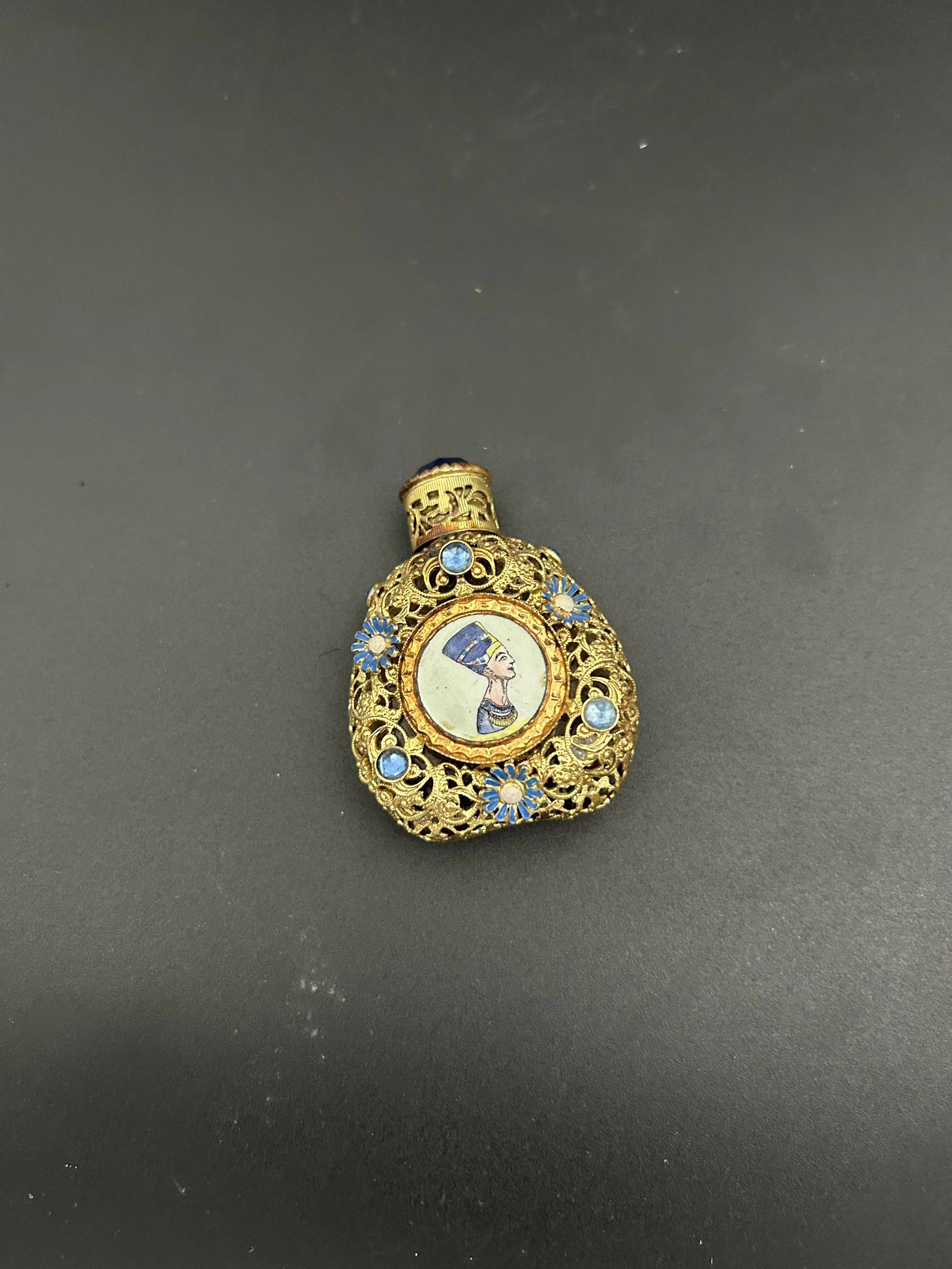
Item No. RSF – V – 4 – γ – 75
Object Description
A miniature Egyptian perfume bottle produced by Chabrawichi, the Cairo perfume house founded in 1920 and still trading today. The body is a small glass flask sheathed in pierced gilt-metal filigree, set with cabochons the deep blue of the river at night and small enamel daisies, and centered on the obverse with a hand-painted miniature of Queen Nefertiti under a glazed roundel. The cap is a high domed cabochon of Egyptian blue. The lid has fused to the collar and will not open. A faint residue remains within the glass, though the scent itself is long gone.
Physical Details
Gilt filigree over glass, slim and palm-sized. Cobalt cabochons at the shoulders and around the cap, five enamel blossom motifs, and a stamped collar in the Egyptian Revival manner. The Nefertiti miniature is hand-painted and bright. Honest wear consistent with a near-century-old vanity object: light loss to the gilding at the high points, settings tight and secure, cap fused, faint dried residue within. Good vintage condition.
Dimensions
Approximately 3.25" × 2.25" (estimate, pending measurement).
Tradition
This piece belongs to the Arabian and Islamic tradition of the djinn جني (jinnī). In that cosmology the djinn are not ghosts of the dead but a separate creation, made of smokeless fire, older than mankind and dwelling in the liminal places of the world. They may be cruel or generous, and they are known to fold themselves into a beautiful object and wait inside it. The motif of the spirit bound in a vessel is ancient in the region. King Sulayman was said to have sealed rebellious djinn into stoppered vessels of brass, and from that tradition descends every later story of the spirit in the bottle. The djinn that choose perfume and ornament, by the reckoning of those who know them, tend to be of the gentler kind. They love scent, glamour, and being adored, and they reward those things in kind.
Story
The last names of the families affected by this story have been omitted for their safety and privacy.
In the winter of 1934, with the world still feverish over the boy king whose tomb had been opened just a decade before, a young American woman we will call Adeline came up the Nile on a hired dahabeah. She had money that was new to her and a husband who had decided, at the last moment, not to come. In his place she brought the one companion she trusted without reservation: a card reader out of New Orleans who worked under the name Madame Vasquine. Adeline did nothing without the cards. She had not booked the passage, nor bought a single hat, nor turned away a single admirer, before Madame had laid the deck across the green baize of her little folding table.
Cairo that season was dust and jasmine and the noise of motorcars, and everywhere the talk was of curses and gold. In a perfumer’s stall off the Khan el-Khalili, Adeline found the bottle. It was small enough to close her hand around, gilt filigree wrapped over glass, set with stones the color of the deep river at night, and on its face a little painted queen looked out from under glass. The perfumer told her the house was Chabrawichi, that the scent inside was made for queens. Adeline paid without bargaining, which is not done, and carried it back to the boat pressed against her heart.
That evening Madame laid the cards and went very still. She turned the Moon, and then the Tower, and then she set the deck down and did not finish the reading. “There is someone already living in it,” she said. “In the bottle. He has been waiting a long while for a woman who would not bargain.” Adeline laughed and asked whether he was handsome. Madame did not laugh. She said the old people of that country knew a kind of spirit made not of clay or of breath but of fire without smoke, and that such a one will sometimes fold itself into a beautiful thing and wait there, patient as scent, for an owner worth the trouble. She said the spirit was not unkind. She said it would have to be adored.
And it was. That winter Adeline could not lose. She was luckier at cards than Madame, which had never once happened. Men who had not noticed her in New York wrote to her now from three cities. She woke each morning feeling that the day had already been arranged in her favor. The bottle she kept always at the center of whatever room she was given, among flowers, among her good things, and she never let the maid touch it. Once, hurried and careless, she packed it down into the bottom of a trunk under her boots, and within the week she lost a bracelet, a friendship, and very nearly a finger in the slammed door of the cabin. She understood. She took the bottle out, set it among the lilies, and apologized to it aloud, and the luck came back the way warmth comes back into a cold room.
Madame read for the spirit directly after that, the cards spread before the bottle rather than before Adeline, and this became their habit. The answers came plainly. It wished to be kept beautiful. It wished never to be emptied, so that something of the scent it loved would always remain. It wished, above all, to be wanted. In exchange it gave what it had always given the women who kept it well: glamour, and the particular abundance that follows a person who has decided, somewhere a spirit can hear it, that she deserves a good life.
Adeline went home in the spring a different woman than the one who had sailed, and she lived, by every account that reached us, extremely well. The bottle stayed with her to the end, and after her it went on, as these things do, to whoever next would set it among the flowers and never let it be emptied. The scent is gone now. The spirit is not. It waits behind the fused lid, where it has been since before Adeline, with the patience of perfume, for the next owner who will not bargain.
Provenance
Manufactured by the House of Chabrawichi, Cairo, c. 1930s; earlier ownership unknown; private collection, California; Rooks–St. Felix, 2026 to present.
Supernatural Scale: 4
A communicative djinn. It answers through cartomancy and in dreams, rewards adoration with glamour and abundance, and withdraws its favor when the bottle is emptied, neglected, or handled roughly.
Maintenance Scale: γ (Gamma) — Intermediate
Keep the bottle at the center of a beautiful room and among beautiful things. Never attempt to force the lid or empty it. Set fresh flowers near it and, on occasion, a single drop of fine perfume on the cloth beneath it as an offering. The owner who wishes to speak with it should do so through cards. Adored, it is generous. Forgotten, it sulks, and the luck goes with it.
About our approach
We have all wandered the halls of antique malls and felt strange eyes gaze upon our backs, perhaps a whisper in the stale air, or even a chill down the spine. Items can become supernatural in many ways. Our focus is different. We curate only the rare pieces where the supernatural and the luxurious meet, because entities and forces that choose beautiful objects tend to be benevolent. Many act as abundance magnets for the owner, or as catalysts for emotionally fulfilling love lives. The items we pick are meant to be luxury and bring in luxury. We believe the spirits can help us in our lives if we let them.
Your Questions, Answered
-
Every item we select has been screened for supernatural phenomena. Only items that are of a scale of 3 or above on our supernatural scale are selected for the store.
-
The supernatural scale is a grading system used by RSF to classify the potential power of an item. Please go to our section regarding our scaling system to learn about it more in depth.
-
We curate our items based on luxury and paranormal phenomena. In other words, just because an item is active or conversely just because an item is luxury does not mean it would fit in the RSF model. We choose items deliberately for the collectors wishing to acquire only the most luxurious haunted items on the market.
-
We created a scale for haunted item management that will let you know the type of expertise needed to handle an item properly. We mostly deal with items we rank gamma or above. Please visit our section on our grading scale.
Begin a Private Dialogue
Share your aspirations; we will craft a bespoke path together.