
 Image 1 of 5
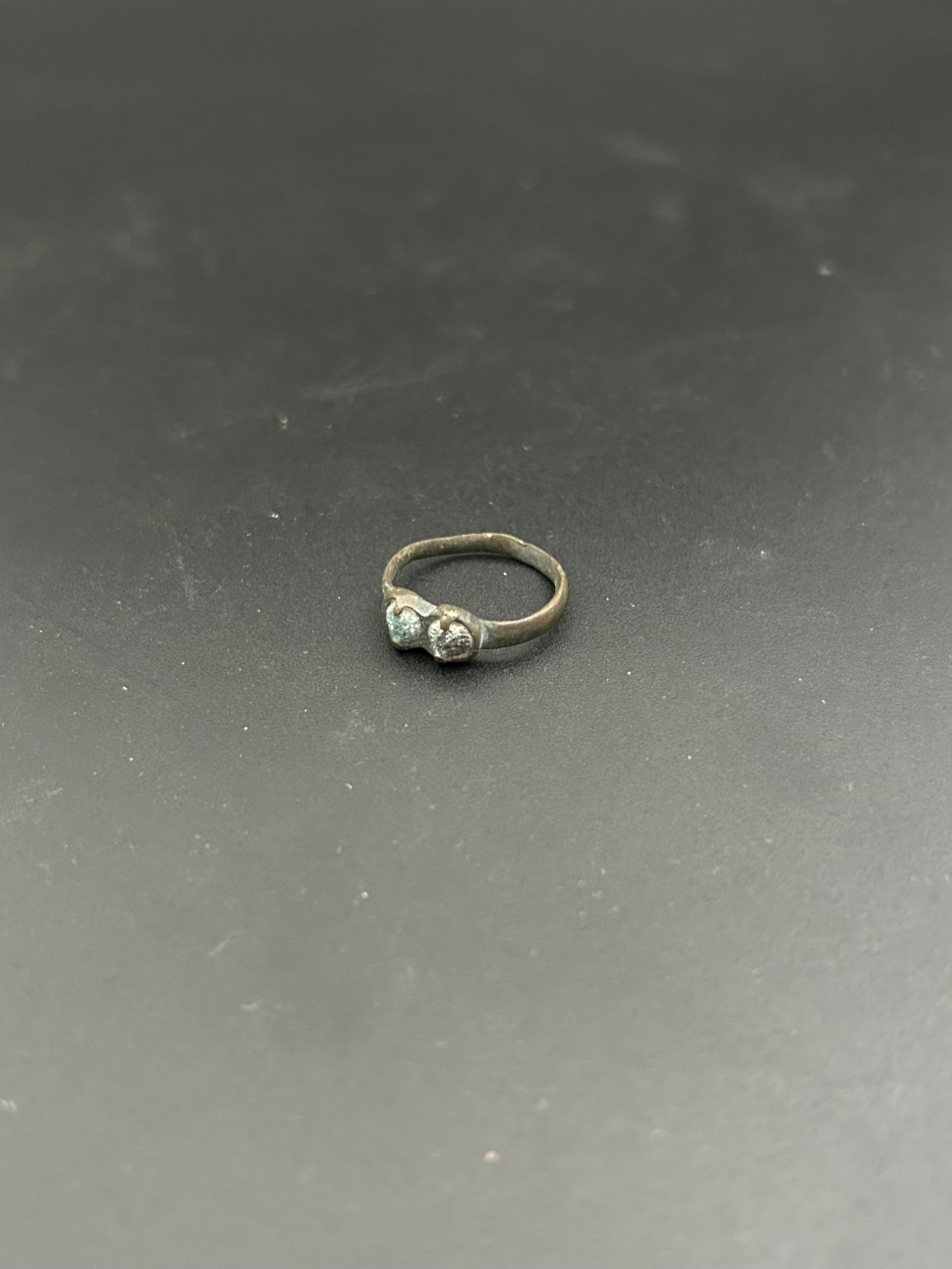 Image 2 of 5
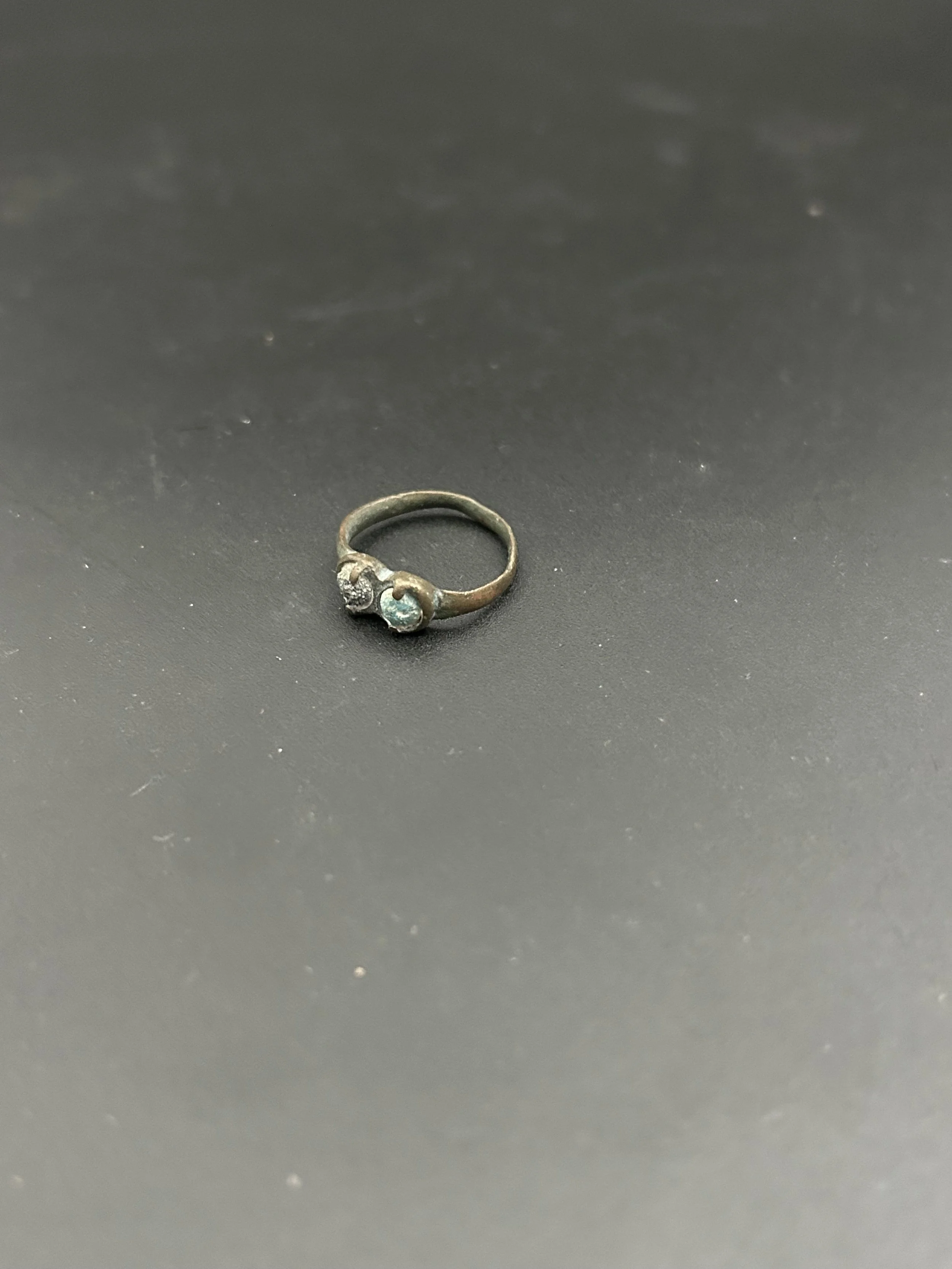 Image 3 of 5
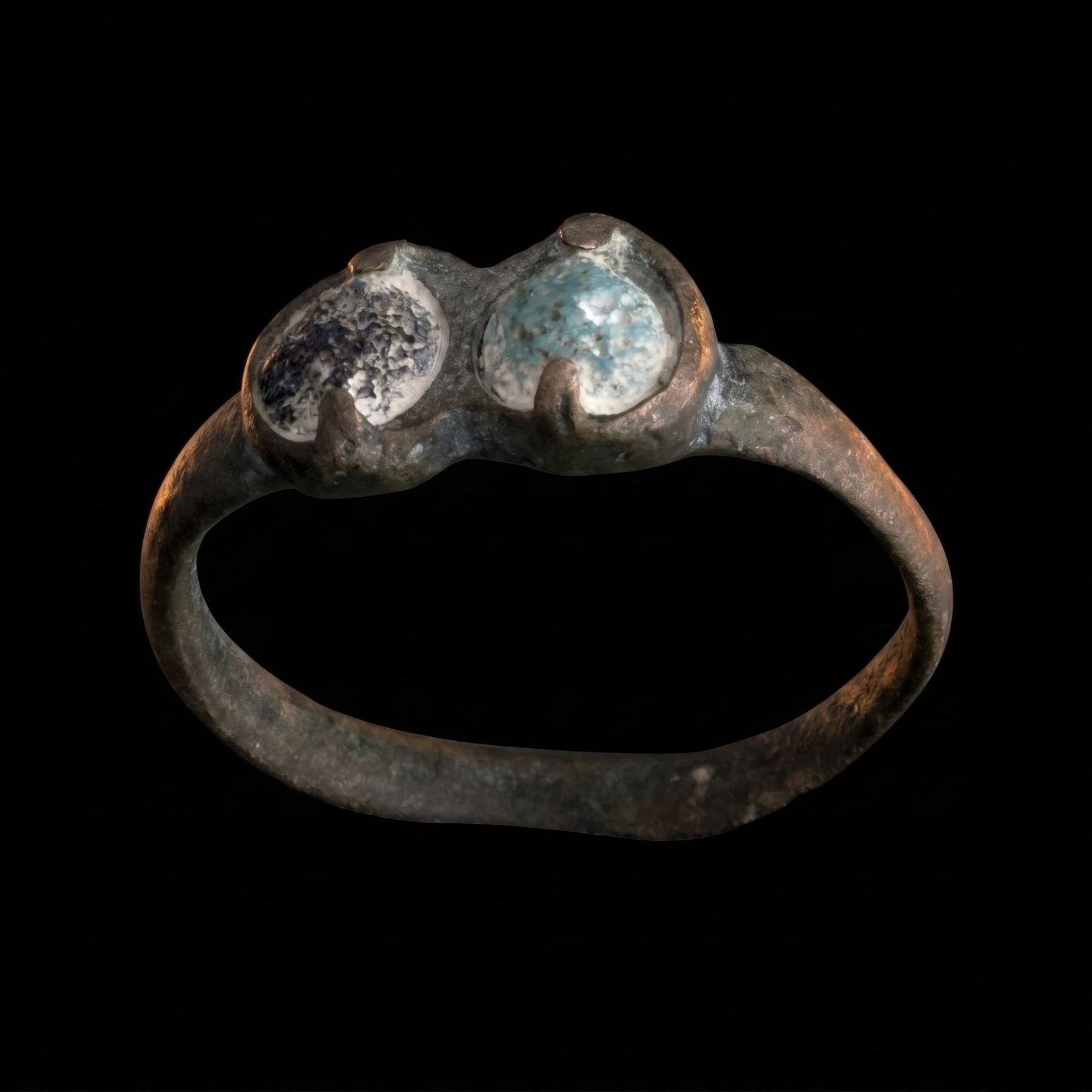 Image 4 of 5
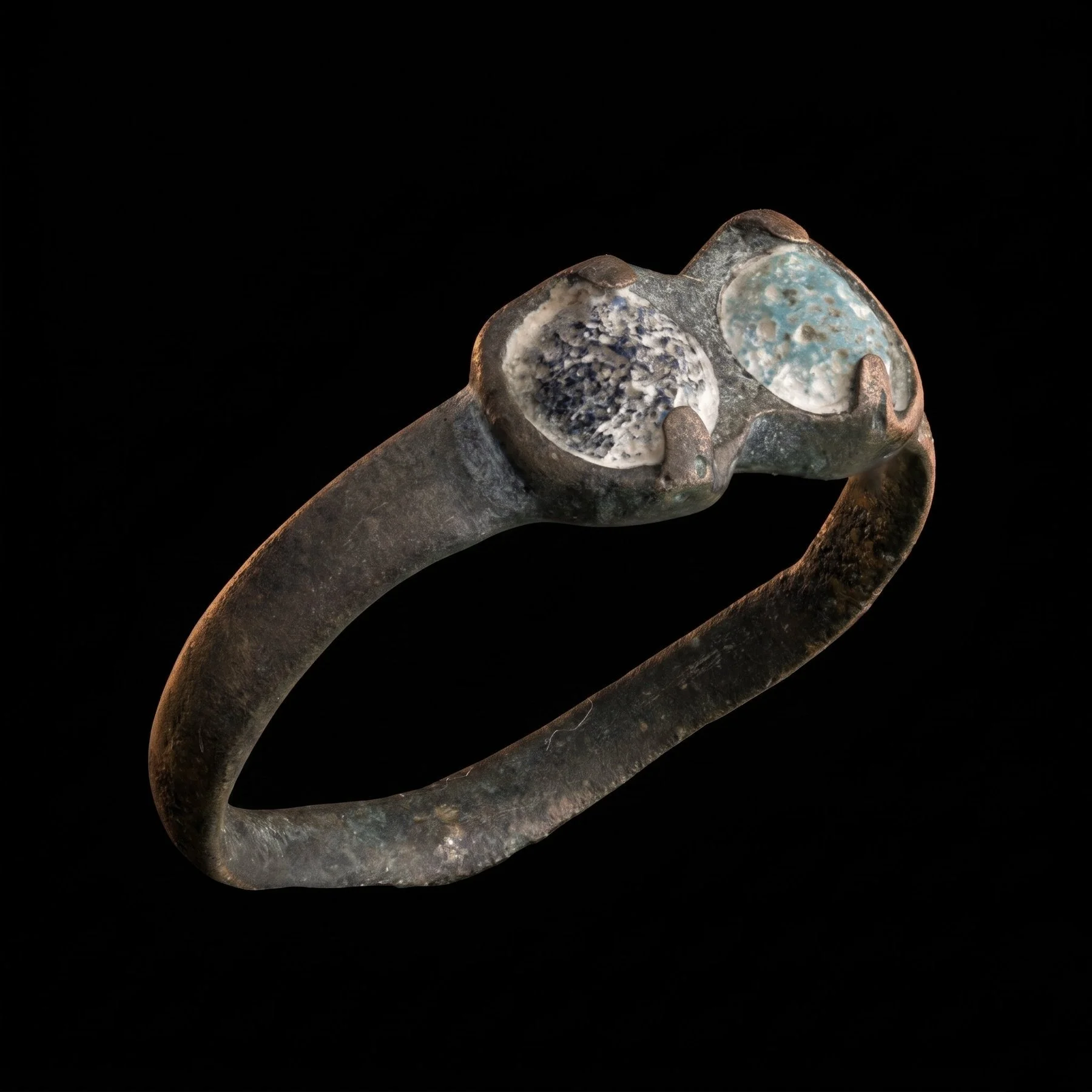 Image 5 of 5
The Tale of the Ring of Good Fortune, a Haunted Medieval Bronze Jewish Protection Ring, c. 12th to 15th Century, Crusader Era - Tekhelet and Ayin Hara
Item No. RSF – J – 3 – β – 33
Object Description
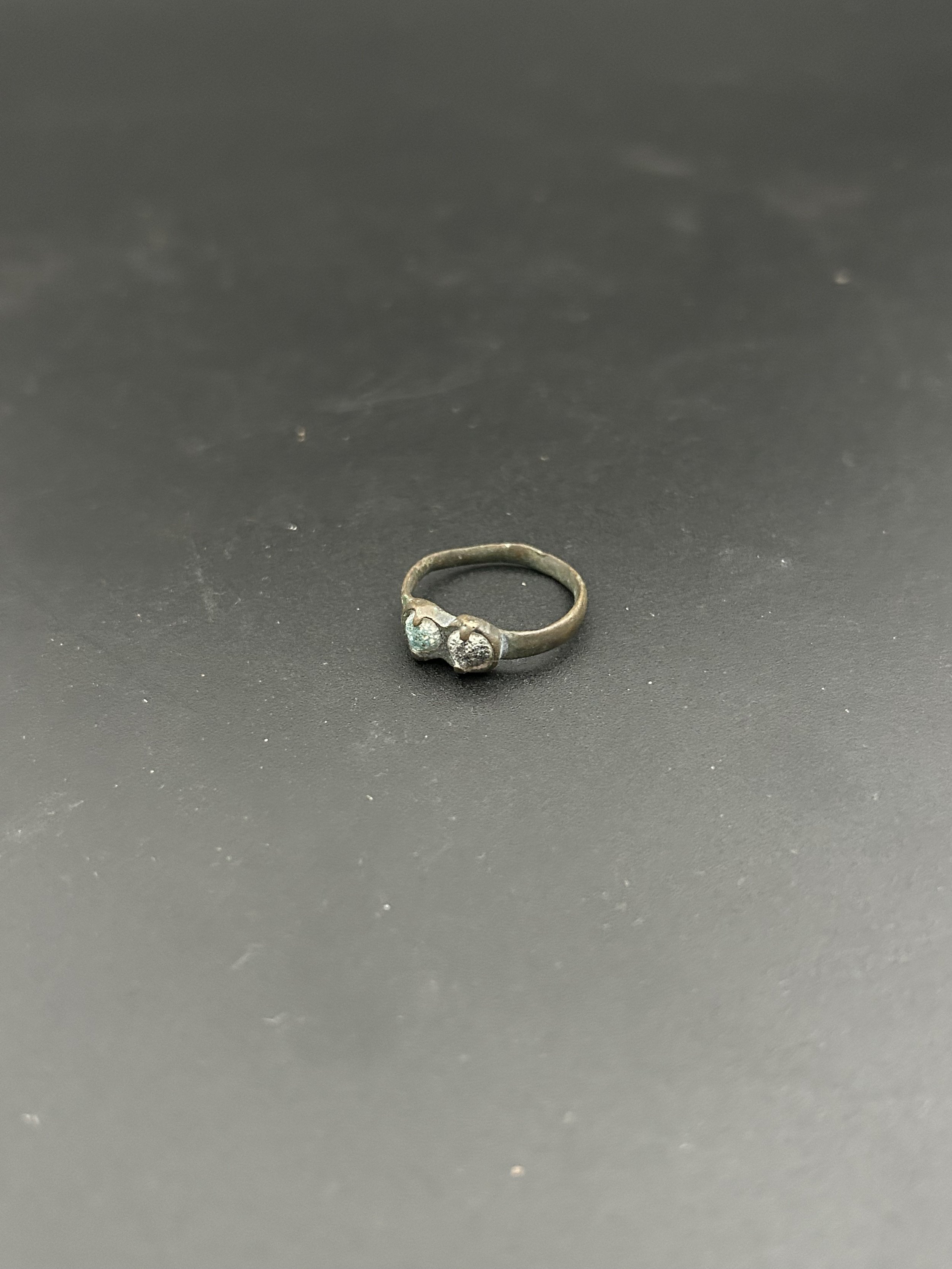
This remarkable bronze ring presents a highly unusual dual-bezel composition incorporating contrasting dark and blue inlays, a symbolic arrangement that may reflect protective and apotropaic traditions known throughout the medieval Eastern Mediterranean and the Levantine Jewish world.
Physical Details
The ring’s paired circular settings evoke a striking ocular appearance, possibly referencing symbolic watchful eyes intended to repel hostile or negative forces. Such dual compositions are known within wider Near Eastern and Eastern Mediterranean amuletic traditions, where contrasting colors and symmetrical arrangements carried protective significance. The darker inlay may likewise possess symbolic value connected to balance, concealment, spiritual defense, or absorptive protective properties, concepts that appear across various medieval Jewish, Levantine, and broader regional folk traditions.
The overall appearance suggests an object intended not merely for adornment but for personal protection and symbolic identity within the spiritually layered environment of medieval Jerusalem and its surrounding cultural sphere. As with many medieval amuletic objects from the region, precise attribution remains interpretive and is best approached through comparative typological and iconographic analysis rather than definitive certainty.
Dimensions
H: 21.2 mm; O: 19.7 mm; I: 17.3 mm; Weight: 1.85 g. (EU 55 / UK O / US 7.25.)
Tradition
Particularly significant is the preserved blue inlay, whose coloration recalls the sacred concept of Tekhelet (תְּכֵלֶת), the revered blue tone deeply embedded within Jewish religious and mystical tradition. In medieval Jewish belief, blue hues were frequently associated with divine protection, heavenly symbolism, and spiritual perception. Across Levantine Jewish communities, blue glass, stones, and pigments were also connected to protection against the Ayin Hara (עין הרע), the evil eye.
Story
Isaac was born a street urchin, to a brothel worker and no known father. His early days at the brothel were formative. He learned to respect the women and the clients who frequented it. The owner of the brothel, taking a liking to the boy, began to teach him the sacred art of accounting. In this, Isaac felt he could surpass anyone. He felt the numbers spoke to him, like angels, each with its own unique resonance.
In turn, Isaac became very valuable to the brothel. Not only was he good with numbers, but he was also honest. The owner could count on him to ensure that everything was in order. Indeed, Isaac felt a sense of honor and pride in being honest.
As he grew into his teenage years, Isaac became restless. He began to wander the streets of the suq, looking for what his great life adventure would be. One hot day, an old merchant stopped him on the street.
“You’re the boy who works at the brothel,” he said.
“Yes, sir.”
“I heard that you’re a genius with numbers.”
“They speak to me, sir.”
“What do they say?”
“They tell me the truth of the matter.”
The man looked at the boy. He knew he had found the person for the job he had in mind. He invited Isaac into his tent for some tea. And with that he began this story.
Long ago, in ancient Baghdad, I had a large house. There was a big courtyard full of flowers and a fountain that cooled the air. The scent of jasmine and incense filled the halls. I was a rich man with many daughters but no son. One day, one of my caravans returned from a trading mission in Arabia. The leader came to my house to celebrate with a great feast. We dined and enjoyed many dates and pistachios, drinking wine until late. He then approached me and asked for my eldest daughter’s hand in marriage. Having no son, I told him I would consider his proposal seriously.
But the man was dishonest. While I slept, he and his men came to my house and took me deep into the desert. I woke up with nothing but my clothes and this ring, this blue ring of protection that they could not take off my hand. I wandered the desert until I came across an oasis and a trading caravan. I explained my situation to them, but they could not believe me. How can an old man be brought thousands of miles from Baghdad to here in a single night? It must have been a djinn that transported you to this wretched place. The caravan was heading the opposite direction, and having no choice, I joined them. And so you see, now I am here, without a son, without my fortune, but with this small tent I obtained through trading and working with numbers.
Isaac took a sip of his tea. The man looked at him while taking the blue ring off his index finger.
“I know that if you wear this and go to Baghdad, you will find my house and my fortune.” He handed Isaac the ring. Isaac put it on and looked at the blue stone. He looked up at the man, but the man was not there. There was no tent, only the cup of tea he had been drinking. Isaac walked home, contemplating his strange encounter.
The next day, Isaac took his savings and bought a camel. He would cross the desert and reach Baghdad to see if the old man’s story was true. He knew it would take him several weeks if not months by land. With little money, he set off on the journey.
After a few weeks on the road, Isaac came across an old widow calling for help. Her goat had climbed to the roof of her house and she did not know how to get him down. Isaac stopped and helped. The woman invited him to her house for dinner as a thank you. Isaac did not refuse. He had not had a proper meal since he left. The meal itself was meager, but it felt like a great feast to him. The next day, Isaac woke beside his camel, surrounded by gold treasures.
Isaac could not believe his eyes. Maybe it was a djinn he had encountered, or an angel. He could not be sure, but he knew it was a twist of good luck. He kissed the ring the old man had given him and continued his journey to Baghdad.
One evening he stopped at an inn at the edge of a town. With so much gold he was carrying, he did not want to attract attention. The inn was quiet but busy, full of workers scurrying about, making preparations. That night the inn erupted in a wedding party. Isaac felt worried about his gold, but he knew the ring would protect him. He joined the party and gave the groom and bride a small gift from his hoard of treasures.
The next day, the father of the bride offered to take Isaac straight to Baghdad. Isaac took the opportunity, since the next stretch of the journey was hounded by armed robbers. It took two weeks to finally reach the city. When he did, he did not know which house would belong to the old man. He stopped at another inn and ordered a meal. He overheard the innkeeper talk about a house, an old house, full of ghosts, that had once belonged to a rich man. Knowing this must be the house, Isaac asked the man to describe it so that he might search for it later.
Isaac began to stroll the crooked alleys of the old city. After searching for several days and ready to give up, he finally came across the foreboding house. He climbed the wall and entered the dead courtyard. The old fountain was no longer running. The house smelled of death and decay.
“Who dares enter my house?” a voice called.
“It is I, Isaac. I am here, sent by the old master of this house, to reclaim it as his adopted son.”
The spirit growled and groaned. The wind picked up and a great dust storm enveloped the house so that nothing could be seen. Isaac stood firm and held his ring up at the dust devil. Then the sand dissipated. The fountain began to run. The garden in the courtyard began to bloom. The scent of jasmine filled the halls. Then a door opened, and a beautiful woman appeared.
“I am the daughter of the man who sent you here, and I will be your wife.”
And with that, Isaac lived a happy life as a rich man both in material wealth and in spirit. He wore the ring until his death, knowing it could protect him from the evil eye.
Provenance
By tradition: an old man of Baghdad (c. 12th century), then Isaac of the Levant (c. 15th century); long buried, excavated in the Eastern Mediterranean; offered at auction; Rooks–St. Felix, 2026 to present.
Supernatural Scale: 3
This ring offers protection from supernatural entities and from the evil eye, while also bestowing material fortune on the one who wears it in good faith.
Maintenance Scale: β (Beta) — Beginner
Low maintenance, but not no maintenance. The ring wants to be worn or kept close, and it wants to be kept clean and bright, since its protection lives in the blue. Treat it as Isaac did, with honesty and respect, and it will guard you and draw fortune toward you. It does not reward the greedy or the cruel.
Item No. RSF – J – 3 – β – 33
Object Description
This remarkable bronze ring presents a highly unusual dual-bezel composition incorporating contrasting dark and blue inlays, a symbolic arrangement that may reflect protective and apotropaic traditions known throughout the medieval Eastern Mediterranean and the Levantine Jewish world.
Physical Details
The ring’s paired circular settings evoke a striking ocular appearance, possibly referencing symbolic watchful eyes intended to repel hostile or negative forces. Such dual compositions are known within wider Near Eastern and Eastern Mediterranean amuletic traditions, where contrasting colors and symmetrical arrangements carried protective significance. The darker inlay may likewise possess symbolic value connected to balance, concealment, spiritual defense, or absorptive protective properties, concepts that appear across various medieval Jewish, Levantine, and broader regional folk traditions.
The overall appearance suggests an object intended not merely for adornment but for personal protection and symbolic identity within the spiritually layered environment of medieval Jerusalem and its surrounding cultural sphere. As with many medieval amuletic objects from the region, precise attribution remains interpretive and is best approached through comparative typological and iconographic analysis rather than definitive certainty.
Dimensions
H: 21.2 mm; O: 19.7 mm; I: 17.3 mm; Weight: 1.85 g. (EU 55 / UK O / US 7.25.)
Tradition
Particularly significant is the preserved blue inlay, whose coloration recalls the sacred concept of Tekhelet (תְּכֵלֶת), the revered blue tone deeply embedded within Jewish religious and mystical tradition. In medieval Jewish belief, blue hues were frequently associated with divine protection, heavenly symbolism, and spiritual perception. Across Levantine Jewish communities, blue glass, stones, and pigments were also connected to protection against the Ayin Hara (עין הרע), the evil eye.
Story
Isaac was born a street urchin, to a brothel worker and no known father. His early days at the brothel were formative. He learned to respect the women and the clients who frequented it. The owner of the brothel, taking a liking to the boy, began to teach him the sacred art of accounting. In this, Isaac felt he could surpass anyone. He felt the numbers spoke to him, like angels, each with its own unique resonance.
In turn, Isaac became very valuable to the brothel. Not only was he good with numbers, but he was also honest. The owner could count on him to ensure that everything was in order. Indeed, Isaac felt a sense of honor and pride in being honest.
As he grew into his teenage years, Isaac became restless. He began to wander the streets of the suq, looking for what his great life adventure would be. One hot day, an old merchant stopped him on the street.
“You’re the boy who works at the brothel,” he said.
“Yes, sir.”
“I heard that you’re a genius with numbers.”
“They speak to me, sir.”
“What do they say?”
“They tell me the truth of the matter.”
The man looked at the boy. He knew he had found the person for the job he had in mind. He invited Isaac into his tent for some tea. And with that he began this story.
Long ago, in ancient Baghdad, I had a large house. There was a big courtyard full of flowers and a fountain that cooled the air. The scent of jasmine and incense filled the halls. I was a rich man with many daughters but no son. One day, one of my caravans returned from a trading mission in Arabia. The leader came to my house to celebrate with a great feast. We dined and enjoyed many dates and pistachios, drinking wine until late. He then approached me and asked for my eldest daughter’s hand in marriage. Having no son, I told him I would consider his proposal seriously.
But the man was dishonest. While I slept, he and his men came to my house and took me deep into the desert. I woke up with nothing but my clothes and this ring, this blue ring of protection that they could not take off my hand. I wandered the desert until I came across an oasis and a trading caravan. I explained my situation to them, but they could not believe me. How can an old man be brought thousands of miles from Baghdad to here in a single night? It must have been a djinn that transported you to this wretched place. The caravan was heading the opposite direction, and having no choice, I joined them. And so you see, now I am here, without a son, without my fortune, but with this small tent I obtained through trading and working with numbers.
Isaac took a sip of his tea. The man looked at him while taking the blue ring off his index finger.
“I know that if you wear this and go to Baghdad, you will find my house and my fortune.” He handed Isaac the ring. Isaac put it on and looked at the blue stone. He looked up at the man, but the man was not there. There was no tent, only the cup of tea he had been drinking. Isaac walked home, contemplating his strange encounter.
The next day, Isaac took his savings and bought a camel. He would cross the desert and reach Baghdad to see if the old man’s story was true. He knew it would take him several weeks if not months by land. With little money, he set off on the journey.
After a few weeks on the road, Isaac came across an old widow calling for help. Her goat had climbed to the roof of her house and she did not know how to get him down. Isaac stopped and helped. The woman invited him to her house for dinner as a thank you. Isaac did not refuse. He had not had a proper meal since he left. The meal itself was meager, but it felt like a great feast to him. The next day, Isaac woke beside his camel, surrounded by gold treasures.
Isaac could not believe his eyes. Maybe it was a djinn he had encountered, or an angel. He could not be sure, but he knew it was a twist of good luck. He kissed the ring the old man had given him and continued his journey to Baghdad.
One evening he stopped at an inn at the edge of a town. With so much gold he was carrying, he did not want to attract attention. The inn was quiet but busy, full of workers scurrying about, making preparations. That night the inn erupted in a wedding party. Isaac felt worried about his gold, but he knew the ring would protect him. He joined the party and gave the groom and bride a small gift from his hoard of treasures.
The next day, the father of the bride offered to take Isaac straight to Baghdad. Isaac took the opportunity, since the next stretch of the journey was hounded by armed robbers. It took two weeks to finally reach the city. When he did, he did not know which house would belong to the old man. He stopped at another inn and ordered a meal. He overheard the innkeeper talk about a house, an old house, full of ghosts, that had once belonged to a rich man. Knowing this must be the house, Isaac asked the man to describe it so that he might search for it later.
Isaac began to stroll the crooked alleys of the old city. After searching for several days and ready to give up, he finally came across the foreboding house. He climbed the wall and entered the dead courtyard. The old fountain was no longer running. The house smelled of death and decay.
“Who dares enter my house?” a voice called.
“It is I, Isaac. I am here, sent by the old master of this house, to reclaim it as his adopted son.”
The spirit growled and groaned. The wind picked up and a great dust storm enveloped the house so that nothing could be seen. Isaac stood firm and held his ring up at the dust devil. Then the sand dissipated. The fountain began to run. The garden in the courtyard began to bloom. The scent of jasmine filled the halls. Then a door opened, and a beautiful woman appeared.
“I am the daughter of the man who sent you here, and I will be your wife.”
And with that, Isaac lived a happy life as a rich man both in material wealth and in spirit. He wore the ring until his death, knowing it could protect him from the evil eye.
Provenance
By tradition: an old man of Baghdad (c. 12th century), then Isaac of the Levant (c. 15th century); long buried, excavated in the Eastern Mediterranean; offered at auction; Rooks–St. Felix, 2026 to present.
Supernatural Scale: 3
This ring offers protection from supernatural entities and from the evil eye, while also bestowing material fortune on the one who wears it in good faith.
Maintenance Scale: β (Beta) — Beginner
Low maintenance, but not no maintenance. The ring wants to be worn or kept close, and it wants to be kept clean and bright, since its protection lives in the blue. Treat it as Isaac did, with honesty and respect, and it will guard you and draw fortune toward you. It does not reward the greedy or the cruel.