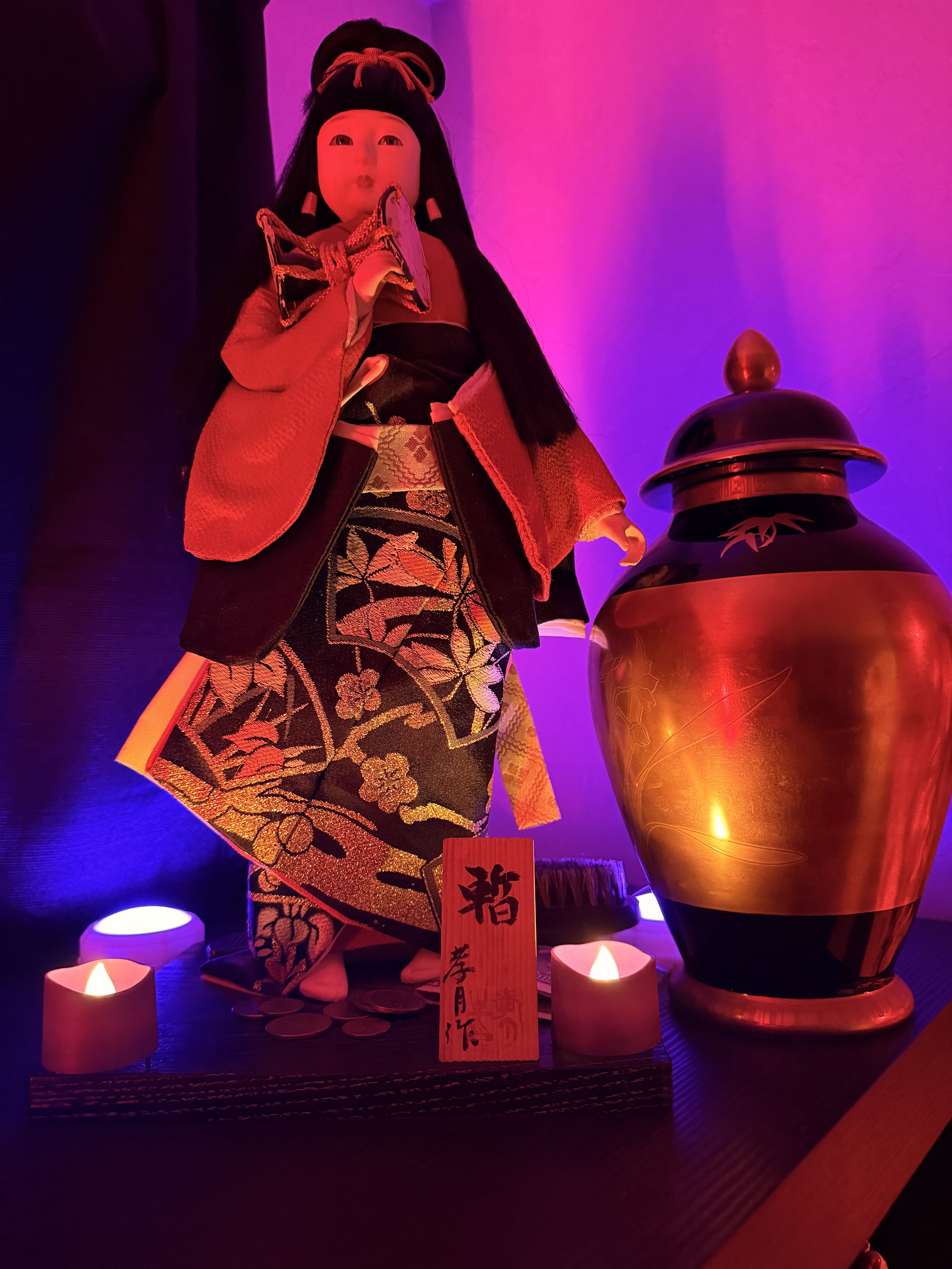
 Image 1 of 4
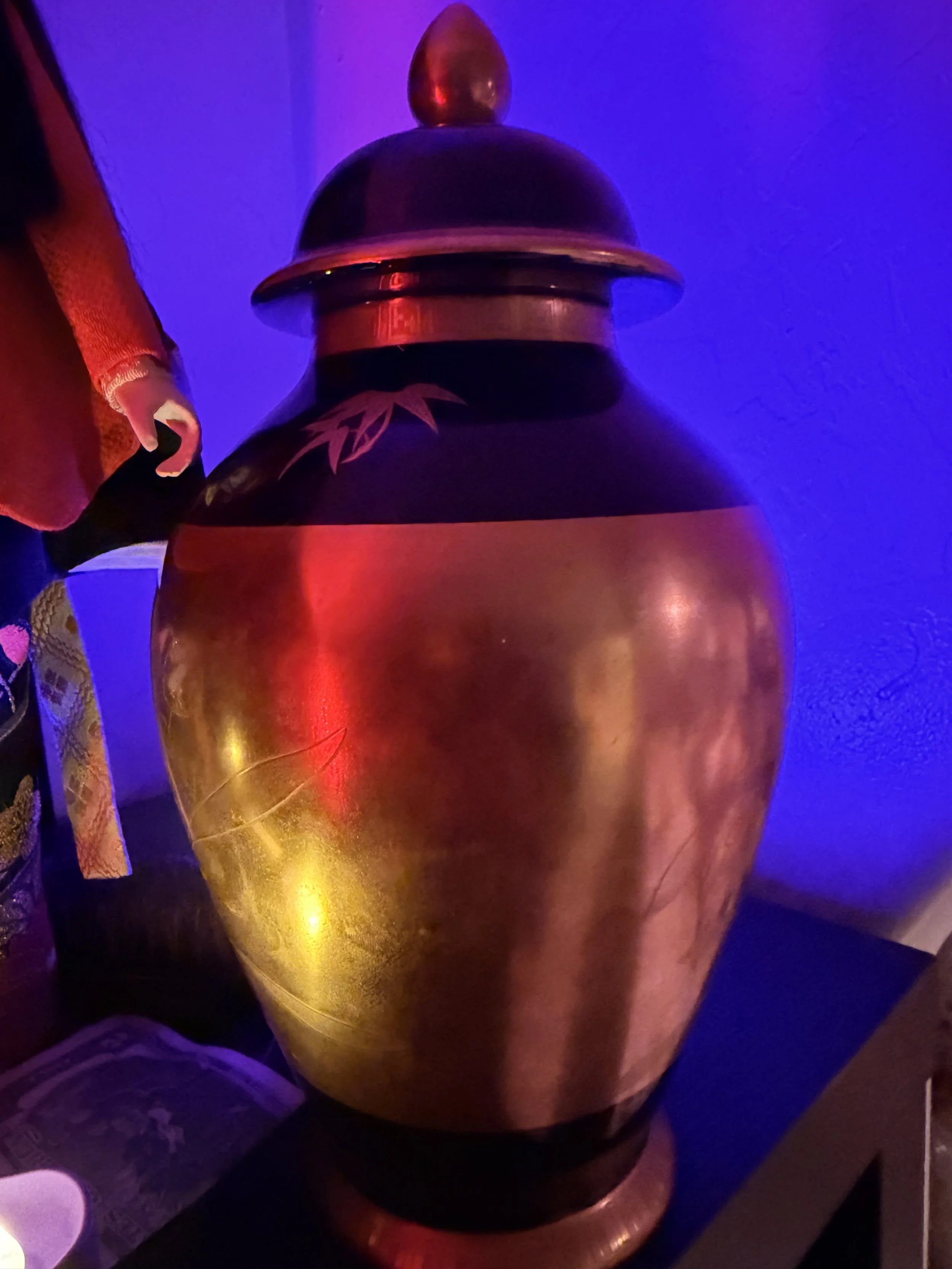
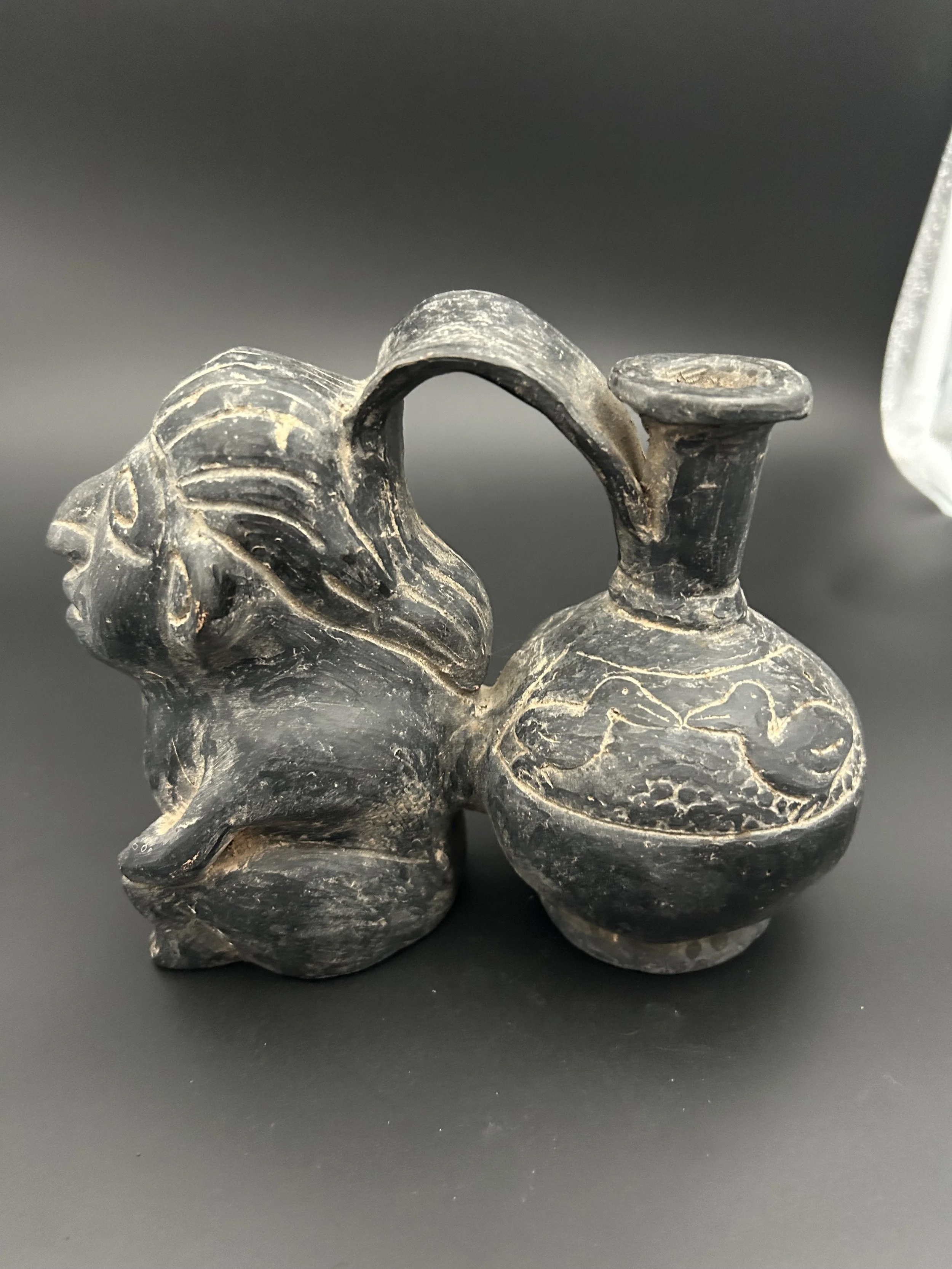 Image 2 of 4
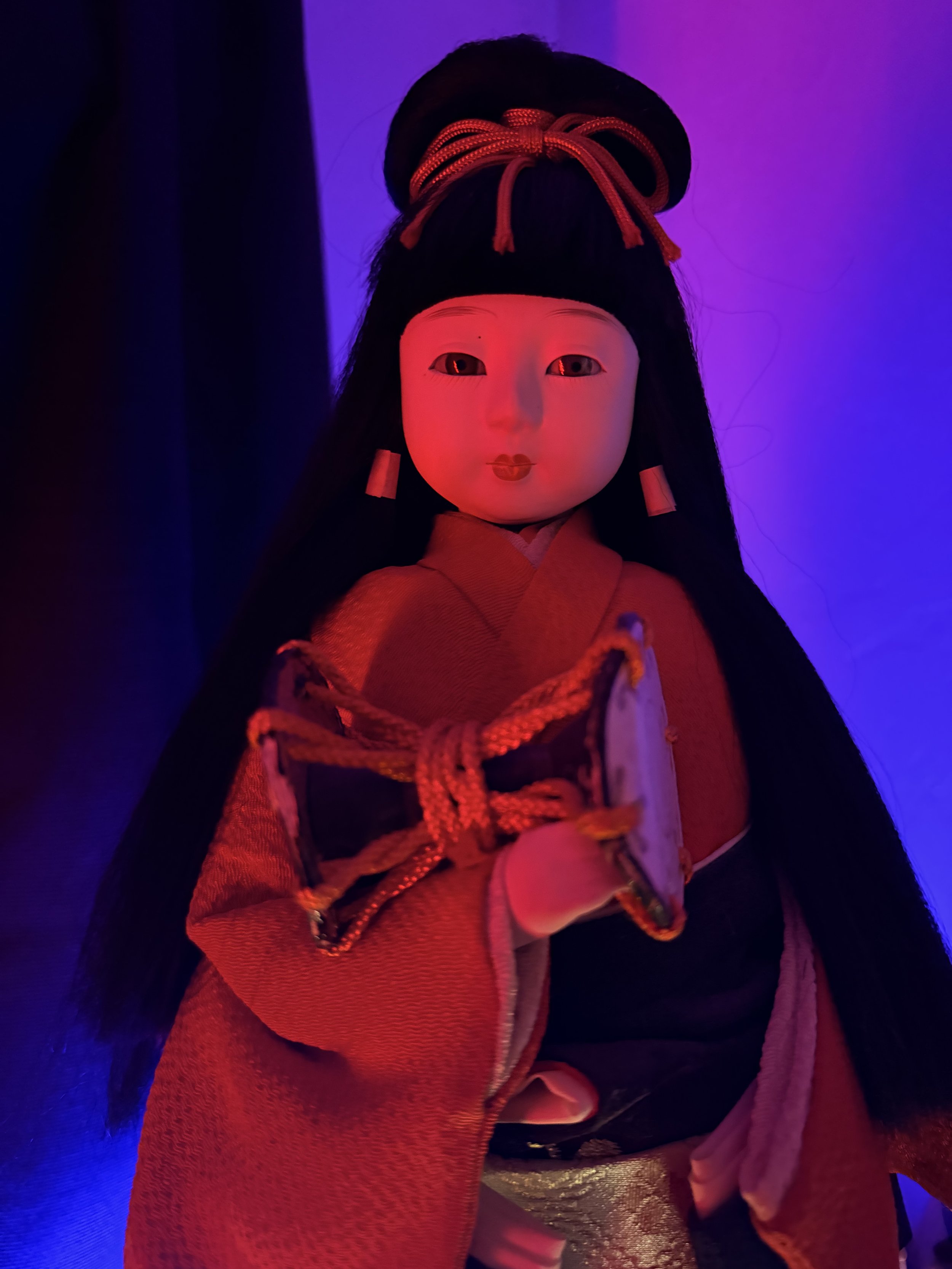
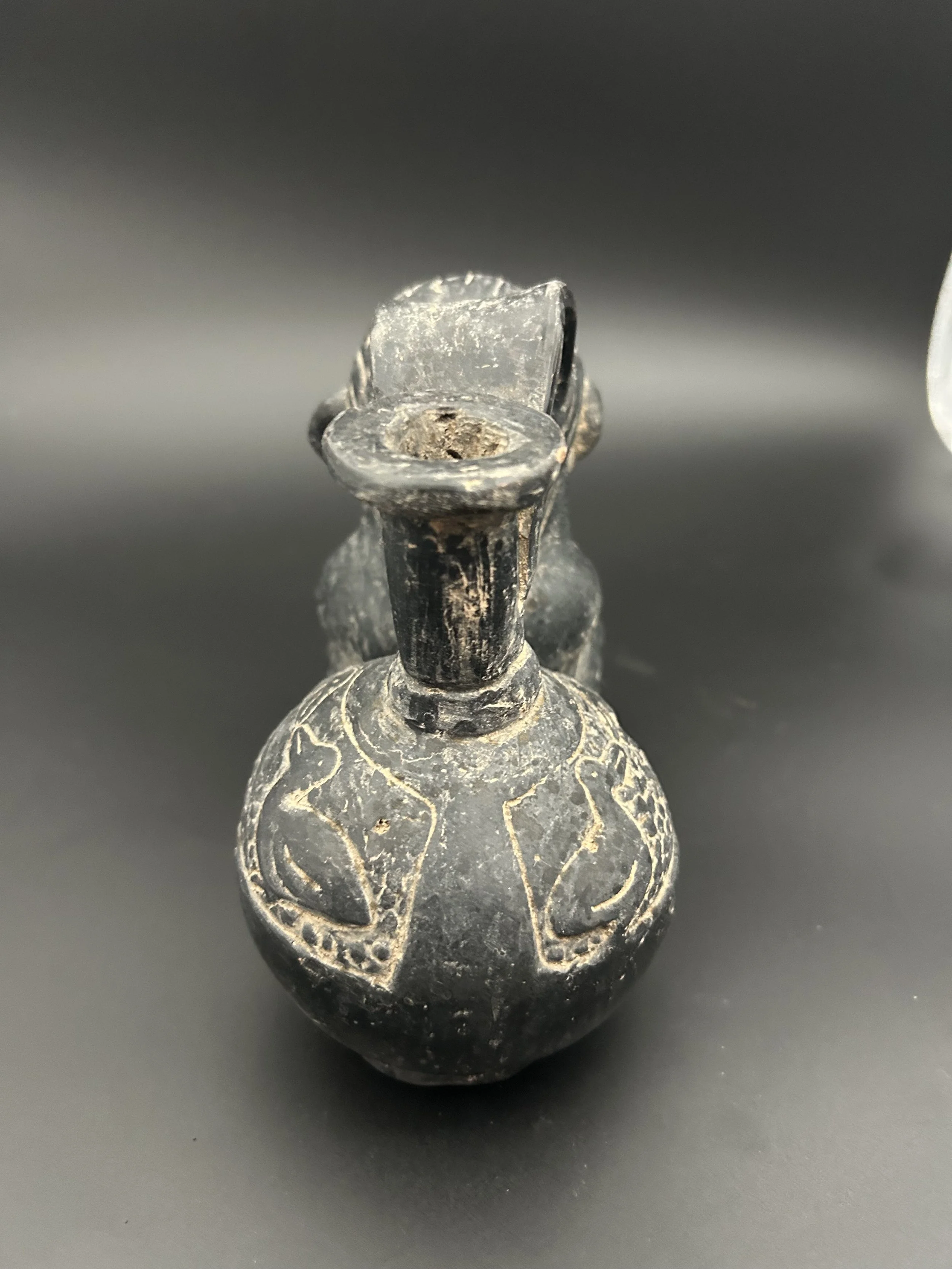 Image 3 of 4
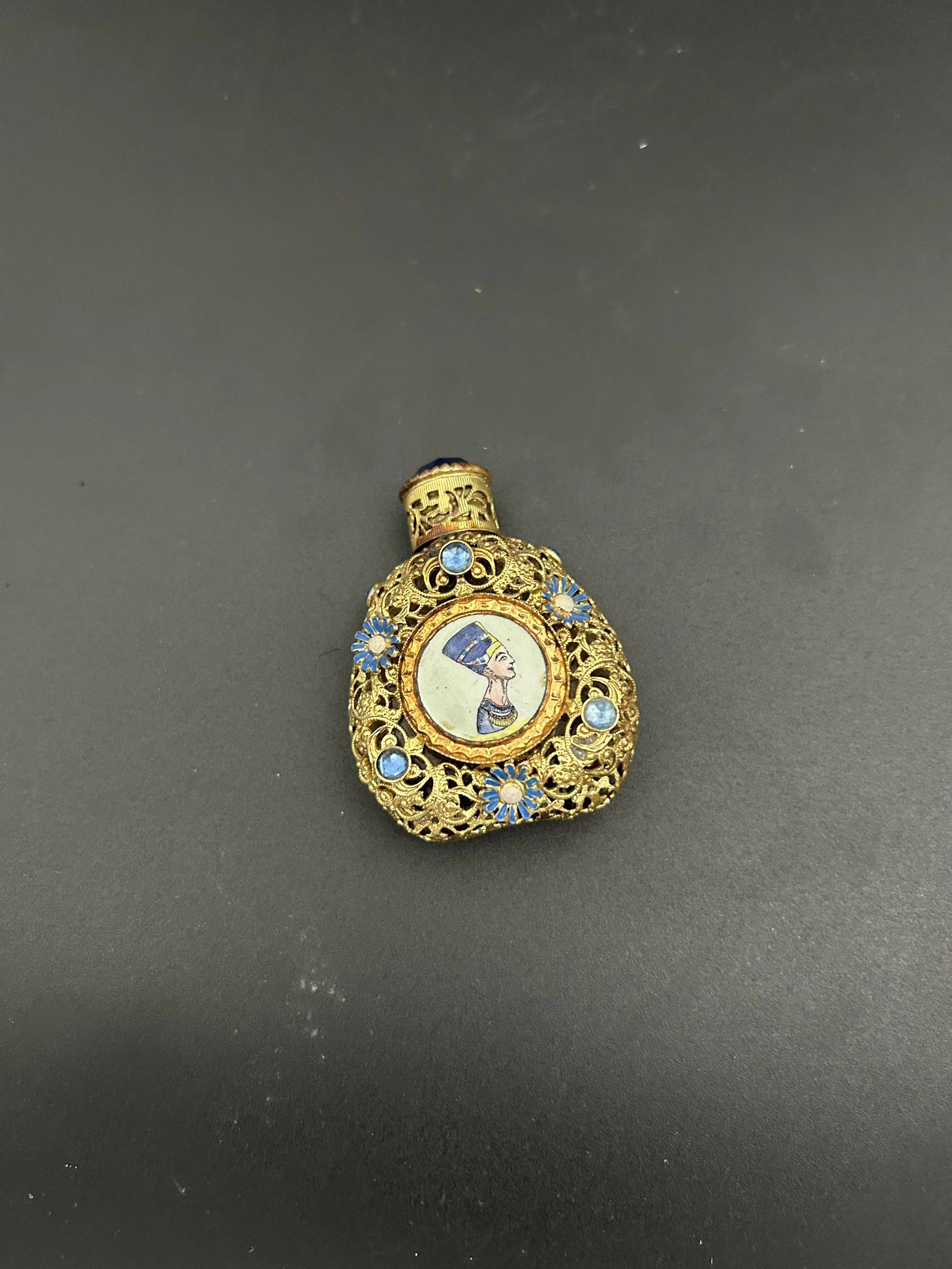
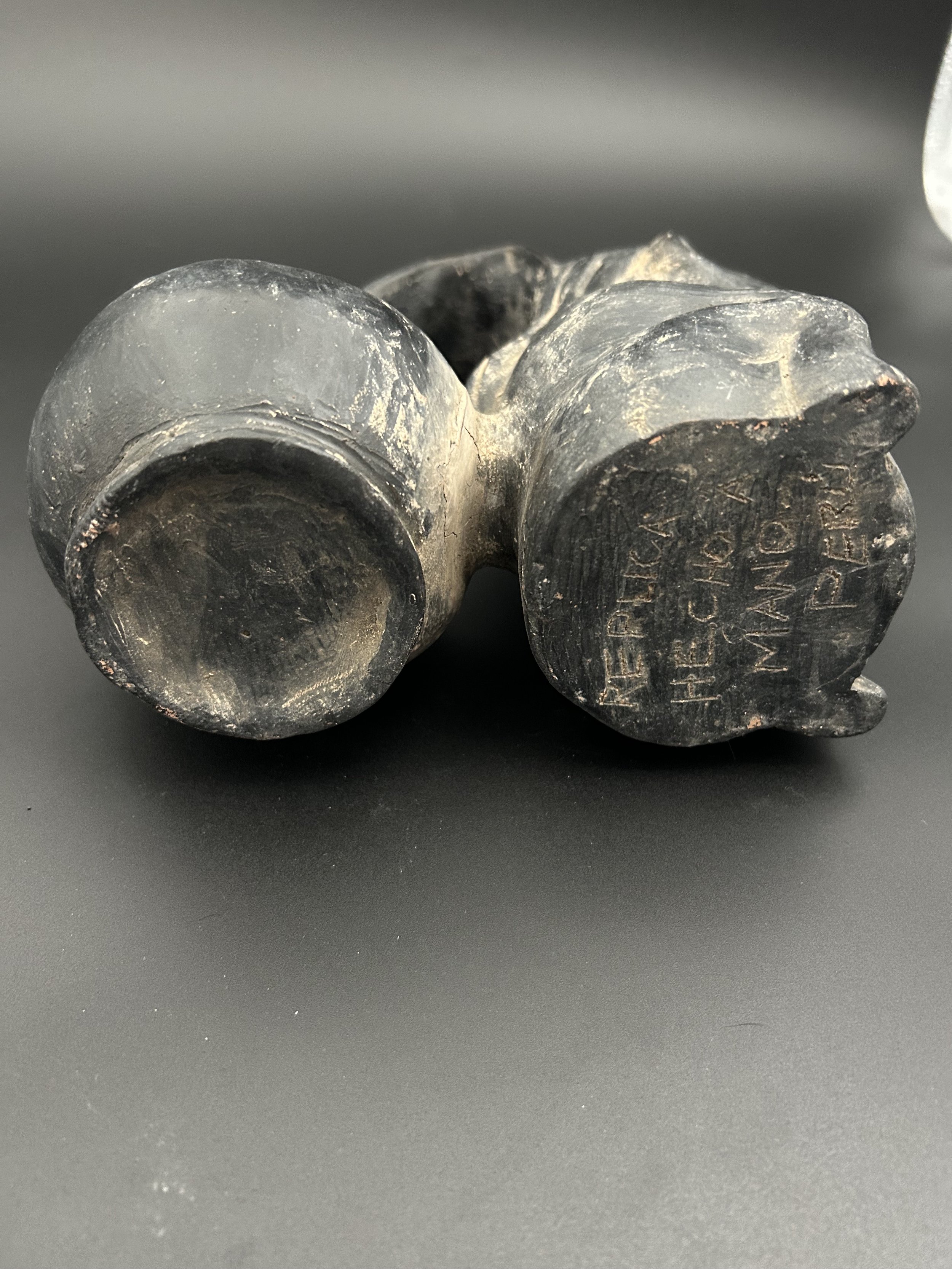 Image 4 of 4
Item No. RSF – V – 3 – γ – 65
Object Description
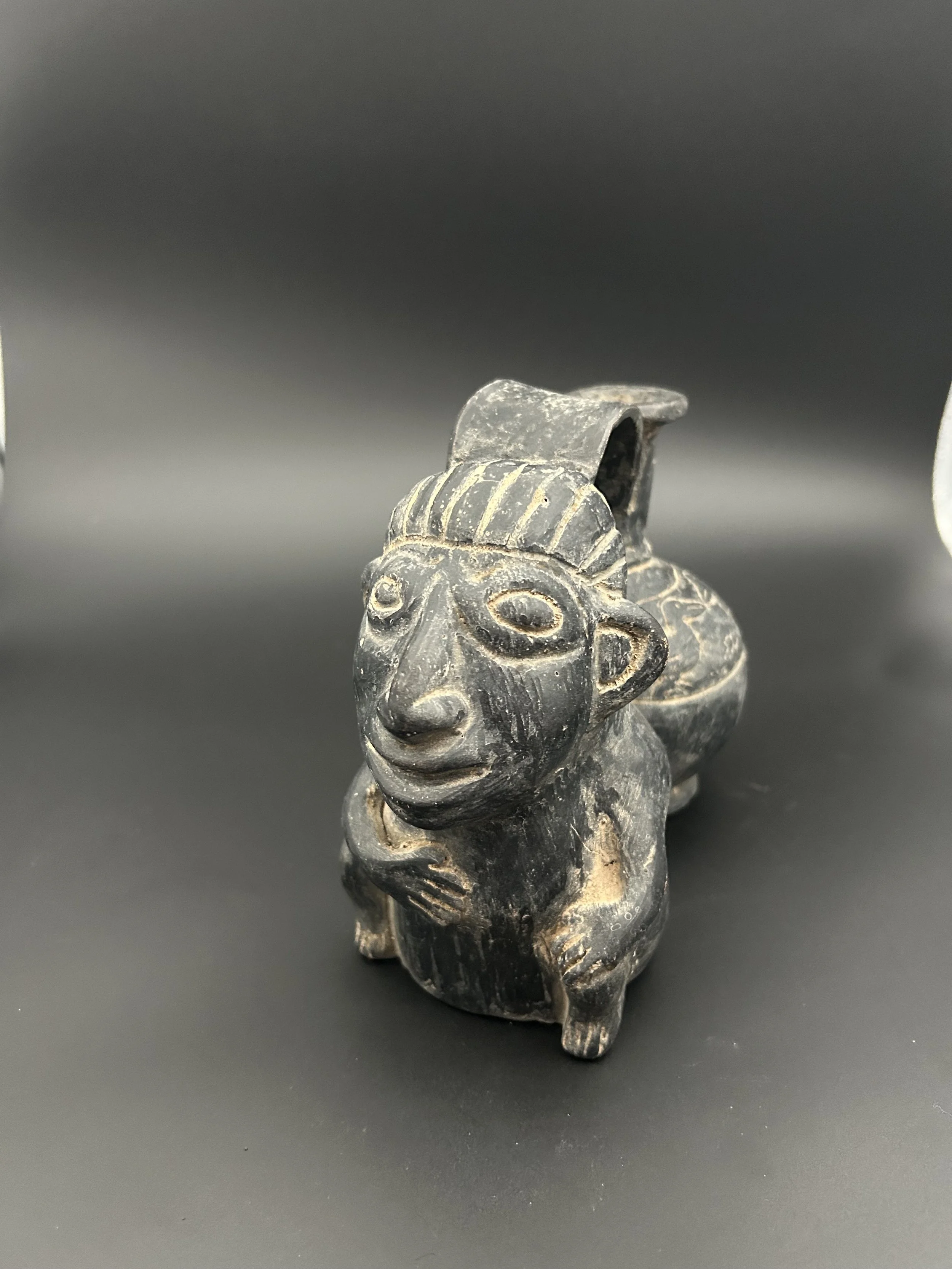
A hand-built blackware vessel made in Peru around 1936 in the Chimú tradition, a 20th-century homage rather than a pre-Columbian antiquity. The form is figural: a small crouching guardian sits on the shoulder of a globular chamber, one hand resting on the rim as if watching the opening, joined to the body by an arching handle. The piece was purchased in Peru in 1936 by Dr. Juan Ortiz Valderrama and kept in his private collection until his death.
Physical Details
Reduction-fired blackware with a glossy, light-drinking surface. The crouching guardian figure is fused to the shoulder of the chamber, and between the figure and the body runs a faint hairline crack, like a scar. A small chip sits near the spout rim, with light earthen deposits in the recessed areas. The chamber is constructed in the whistling-vessel manner and produces a low, breathy tone when air passes through it, which is most likely the source of the whispering reported by its previous owner. Sturdy and stable. Good condition consistent with age.
Dimensions
6.75" × 3.25" × 6".
Tradition
The Chimú built the kingdom of Chimor along the north coast of Peru, the largest and most important state in the Andes before the Inca conquered them around 1470. They were master potters, and their blackware, fired in a reducing kiln until it took on a deep glossy black, is among the most recognizable pottery of the ancient Americas. Many of their vessels were stirrup-spout and effigy forms, and many were grave goods, placed with the dead and often carrying small guardian or servant figures meant to accompany the buried into the next world. A vessel like this one is a replica, made centuries later, but it was made in Peru in the old manner by hands steeped in the tradition, and at Rooks–St. Felix we have found that an object built faithfully in a tradition can sometimes take on the same charge as the originals it honors.
Story
Elena first saw it in the cluttered back room of an estate sale in Miami, listed under a handwritten sign that read “Dr. Juan Ortiz Valderrama, Private Collection.” The black pottery vessel stood alone on a folding table, its glossy surface swallowing the overhead fluorescent light. A small ceramic man crouched on the shoulder of the larger chamber, one hand resting on the rim as if guarding the opening. Between the little figure and the vessel itself ran a faint, jagged crack, like a scar that had never quite healed.
“Came from the doctor’s study. He brought it back from Peru in ’36. Said it was a replica of Chimú work, but who knows. Paid next to nothing back then. His family just wants it gone.”
Elena paid the modest sum and carried the vessel home in a padded box.
At first it was only atmosphere. She placed it on the mantel in her narrow apartment in Coral Gables. The black pottery seemed to drink the light even more than it had in the estate hall. At night the streetlamp outside cast a faint orange glow across the room, and the little carved man appeared to shift position by degrees. Elena told herself it was an optical trick caused by the crack.
Then came the whispering. It began around three in the morning, the hour Dr. Valderrama had died two years earlier, according to the obituary she later found. A dry, rustling sound like wind through dry reeds, or sand pouring across stone. It always came from the direction of the mantel. When she turned on the lamp, the sound stopped. The small figure stared back at her with the same serene expression.
One humid Thursday she came home from teaching to find the vessel turned ninety degrees. The little man now faced the hallway instead of the living room. She had been alone in the apartment for three days. That night the whispering had words. They were not in Spanish or English. The syllables were thick and guttural, the language of a people who had lived along the north coast of Peru centuries before the Inca came. Elena did not understand them, yet she felt their meaning: Return me.
She began to dream of red desert dunes and adobe cities the color of dried blood. In the dreams she was not herself but a potter’s apprentice, shaping wet black clay under a merciless sun. A nobleman stood over her, face painted, demanding the vessel be finished before the next full moon. In his hands he held a smaller figure: the guardian. When the nobleman was displeased with her work, he pressed the guardian’s face into the still-soft rim of the larger vessel, sealing the smaller spirit to the larger one forever. Elena woke with clay under her fingernails.
She tried to research the piece. Chimú culture, 1100 to 1400 AD. Master potters who created stirrup-spout vessels and effigy jars, often blackware fired in reducing kilns. Many were found in tombs. Some scholars believed the figures represented servants or guardians meant to accompany the dead into the afterlife. The small man on her vessel was not a servant.
One night she left her phone recording while she slept. In the morning she played it back. For the first hour there was only the low hum of the air conditioner. Then, at 3:17 a.m., came the whispering again, clearer now. A man’s voice, ancient and patient, speaking directly to the vessel itself. “The water still runs beneath the city. The lords still wait.” A pause. “Why have you brought me among the living again?” Elena’s own recorded breathing hitched. Then, unmistakably, her sleeping voice answered in the same guttural language she had never studied. The words were hoarse, terrified. “I did not know.”
She decided to return it. But the vessel would not leave. When she tried to lift it the next evening, her fingers slid off the glossy black surface as though it had been greased. The earthen deposits inside the recessed areas had darkened, looking almost wet. The crack between the little guardian and the chamber had split further, and inside the fissure she thought she saw movement, like something breathing.
That night the dreams changed. She stood in the ruined city of Chan Chan under a moon that should not have been visible in Miami. The nobleman was there, his face now revealed as Dr. Juan Ortiz Valderrama, younger, dressed in Chimú finery. He smiled the same gentle smile the estate-sale photograph had shown. “You disturbed the balance,” he said in perfect English. “I only wanted to study them. But the guardian does not allow study. Only service.” Behind him, thousands of black pottery vessels stood in silent ranks, each with its own small figure fused to the rim. Elena woke screaming.
At 3:00 a.m. she carried the vessel out to the small courtyard behind her building. The air was thick with coming rain. She set it on the concrete and picked up a brick. The little carved man looked up at her with something like pity. She brought the brick down. The vessel did not shatter. Instead the crack widened with a sound like a sigh, and black dust poured out in a steady stream. The dust coiled upward, forming the vague shape of a man, tall and noble, his face flickering between the ancient lord and Dr. Valderrama. The figure reached out and touched the side of her face with fingers that felt like cool, wet clay. “You kept me too long,” the ghost whispered. “Now the vessel needs a new guardian.”
Elena dropped the brick.
When her neighbor found her the next morning, she was sitting cross-legged on the concrete, calmly pressing her own face into the soft black clay that had somehow appeared around the vessel’s rim. The small figure on the shoulder now wore Elena’s features, serene, watchful, eternally fused. The pottery itself looked newly made. The crack was gone. The earthen deposits had vanished.
Provenance
Made in Peru, c. 1936, in the Chimú blackware tradition; purchased in Peru by Dr. Juan Ortiz Valderrama, MD, 1936; his private collection, Miami, Florida, to 2018; estate; private ownership thereafter; Rooks–St. Felix, 2026 to present.
Supernatural Scale: 3
Rated for what has been reliably observed in our possession: the low whispering tone, cold at the mantel, the occasional turning of the vessel, and a marked aversion in some animals. The Elena account stands as the warning of what neglect, study without respect, or any attempt to discard it may invite. This is a guardian, and a guardian expects service.
Maintenance Scale: γ (Gamma) — Intermediate
Keep it stationary and never treat it as a curiosity to be handled or studied for sport. As a vessel, it is honored by a little fresh water set beside it. Do not provoke it, do not try to part the guardian from the chamber, and never attempt to destroy it. This is a piece for a respectful owner who understands that some objects are kept, not used.
Item No. RSF – V – 3 – γ – 65
Object Description
A hand-built blackware vessel made in Peru around 1936 in the Chimú tradition, a 20th-century homage rather than a pre-Columbian antiquity. The form is figural: a small crouching guardian sits on the shoulder of a globular chamber, one hand resting on the rim as if watching the opening, joined to the body by an arching handle. The piece was purchased in Peru in 1936 by Dr. Juan Ortiz Valderrama and kept in his private collection until his death.
Physical Details
Reduction-fired blackware with a glossy, light-drinking surface. The crouching guardian figure is fused to the shoulder of the chamber, and between the figure and the body runs a faint hairline crack, like a scar. A small chip sits near the spout rim, with light earthen deposits in the recessed areas. The chamber is constructed in the whistling-vessel manner and produces a low, breathy tone when air passes through it, which is most likely the source of the whispering reported by its previous owner. Sturdy and stable. Good condition consistent with age.
Dimensions
6.75" × 3.25" × 6".
Tradition
The Chimú built the kingdom of Chimor along the north coast of Peru, the largest and most important state in the Andes before the Inca conquered them around 1470. They were master potters, and their blackware, fired in a reducing kiln until it took on a deep glossy black, is among the most recognizable pottery of the ancient Americas. Many of their vessels were stirrup-spout and effigy forms, and many were grave goods, placed with the dead and often carrying small guardian or servant figures meant to accompany the buried into the next world. A vessel like this one is a replica, made centuries later, but it was made in Peru in the old manner by hands steeped in the tradition, and at Rooks–St. Felix we have found that an object built faithfully in a tradition can sometimes take on the same charge as the originals it honors.
Story
Elena first saw it in the cluttered back room of an estate sale in Miami, listed under a handwritten sign that read “Dr. Juan Ortiz Valderrama, Private Collection.” The black pottery vessel stood alone on a folding table, its glossy surface swallowing the overhead fluorescent light. A small ceramic man crouched on the shoulder of the larger chamber, one hand resting on the rim as if guarding the opening. Between the little figure and the vessel itself ran a faint, jagged crack, like a scar that had never quite healed.
“Came from the doctor’s study. He brought it back from Peru in ’36. Said it was a replica of Chimú work, but who knows. Paid next to nothing back then. His family just wants it gone.”
Elena paid the modest sum and carried the vessel home in a padded box.
At first it was only atmosphere. She placed it on the mantel in her narrow apartment in Coral Gables. The black pottery seemed to drink the light even more than it had in the estate hall. At night the streetlamp outside cast a faint orange glow across the room, and the little carved man appeared to shift position by degrees. Elena told herself it was an optical trick caused by the crack.
Then came the whispering. It began around three in the morning, the hour Dr. Valderrama had died two years earlier, according to the obituary she later found. A dry, rustling sound like wind through dry reeds, or sand pouring across stone. It always came from the direction of the mantel. When she turned on the lamp, the sound stopped. The small figure stared back at her with the same serene expression.
One humid Thursday she came home from teaching to find the vessel turned ninety degrees. The little man now faced the hallway instead of the living room. She had been alone in the apartment for three days. That night the whispering had words. They were not in Spanish or English. The syllables were thick and guttural, the language of a people who had lived along the north coast of Peru centuries before the Inca came. Elena did not understand them, yet she felt their meaning: Return me.
She began to dream of red desert dunes and adobe cities the color of dried blood. In the dreams she was not herself but a potter’s apprentice, shaping wet black clay under a merciless sun. A nobleman stood over her, face painted, demanding the vessel be finished before the next full moon. In his hands he held a smaller figure: the guardian. When the nobleman was displeased with her work, he pressed the guardian’s face into the still-soft rim of the larger vessel, sealing the smaller spirit to the larger one forever. Elena woke with clay under her fingernails.
She tried to research the piece. Chimú culture, 1100 to 1400 AD. Master potters who created stirrup-spout vessels and effigy jars, often blackware fired in reducing kilns. Many were found in tombs. Some scholars believed the figures represented servants or guardians meant to accompany the dead into the afterlife. The small man on her vessel was not a servant.
One night she left her phone recording while she slept. In the morning she played it back. For the first hour there was only the low hum of the air conditioner. Then, at 3:17 a.m., came the whispering again, clearer now. A man’s voice, ancient and patient, speaking directly to the vessel itself. “The water still runs beneath the city. The lords still wait.” A pause. “Why have you brought me among the living again?” Elena’s own recorded breathing hitched. Then, unmistakably, her sleeping voice answered in the same guttural language she had never studied. The words were hoarse, terrified. “I did not know.”
She decided to return it. But the vessel would not leave. When she tried to lift it the next evening, her fingers slid off the glossy black surface as though it had been greased. The earthen deposits inside the recessed areas had darkened, looking almost wet. The crack between the little guardian and the chamber had split further, and inside the fissure she thought she saw movement, like something breathing.
That night the dreams changed. She stood in the ruined city of Chan Chan under a moon that should not have been visible in Miami. The nobleman was there, his face now revealed as Dr. Juan Ortiz Valderrama, younger, dressed in Chimú finery. He smiled the same gentle smile the estate-sale photograph had shown. “You disturbed the balance,” he said in perfect English. “I only wanted to study them. But the guardian does not allow study. Only service.” Behind him, thousands of black pottery vessels stood in silent ranks, each with its own small figure fused to the rim. Elena woke screaming.
At 3:00 a.m. she carried the vessel out to the small courtyard behind her building. The air was thick with coming rain. She set it on the concrete and picked up a brick. The little carved man looked up at her with something like pity. She brought the brick down. The vessel did not shatter. Instead the crack widened with a sound like a sigh, and black dust poured out in a steady stream. The dust coiled upward, forming the vague shape of a man, tall and noble, his face flickering between the ancient lord and Dr. Valderrama. The figure reached out and touched the side of her face with fingers that felt like cool, wet clay. “You kept me too long,” the ghost whispered. “Now the vessel needs a new guardian.”
Elena dropped the brick.
When her neighbor found her the next morning, she was sitting cross-legged on the concrete, calmly pressing her own face into the soft black clay that had somehow appeared around the vessel’s rim. The small figure on the shoulder now wore Elena’s features, serene, watchful, eternally fused. The pottery itself looked newly made. The crack was gone. The earthen deposits had vanished.
Provenance
Made in Peru, c. 1936, in the Chimú blackware tradition; purchased in Peru by Dr. Juan Ortiz Valderrama, MD, 1936; his private collection, Miami, Florida, to 2018; estate; private ownership thereafter; Rooks–St. Felix, 2026 to present.
Supernatural Scale: 3
Rated for what has been reliably observed in our possession: the low whispering tone, cold at the mantel, the occasional turning of the vessel, and a marked aversion in some animals. The Elena account stands as the warning of what neglect, study without respect, or any attempt to discard it may invite. This is a guardian, and a guardian expects service.
Maintenance Scale: γ (Gamma) — Intermediate
Keep it stationary and never treat it as a curiosity to be handled or studied for sport. As a vessel, it is honored by a little fresh water set beside it. Do not provoke it, do not try to part the guardian from the chamber, and never attempt to destroy it. This is a piece for a respectful owner who understands that some objects are kept, not used.